
Digital collaboration in construction depends on more than powerful tools. It depends on whether those tools can communicate with one another. Interoperability is essential for creating reliable digital workflows, reducing inefficiencies, and enabling better decision-making throughout a building’s lifecycle. We speak with Ane Ferreiro, Product Owner and Project Manager at CYPE, about the company’s role in developing DTERBIM’s openBIM framework.
She explains how her team is helping create a collaborative environment where data, software, and stakeholders can work seamlessly together, laying the foundations for more efficient and interoperable renovation processes.

Tell us a bit about yourself. What path led you to your current role at CYPE?
My name is Ane Ferreiro Sistiaga, and I’m an architect working as a Product Owner and Project Manager in the Development Department at CYPE. My background is architecture, with a strong focus on digitalisation, BIM and interoperability. Currently, I am involved in managing and coordinating software development projects, such as CYPE Architecture (BIM modeller) and CYPE Validation (Digital Building Permits).
What do you find most rewarding about your work? What keeps you motivated?
What I enjoy most is working at the intersection of technology and the built environment. It is very rewarding to see how digital tools can make complex processes simpler and more efficient. I am especially motivated by collaboration—working with multidisciplinary teams and international partners to solve real challenges in the construction sector and contribute to innovation that has a tangible impact.
“It is very rewarding to see how digital tools can make complex processes simpler and more efficient.”
What is CYPE’s role within DTERBIM, and what challenges are you helping to solve?
Within DTERBIM, our team leads Work Package 6, which focuses on developing an interoperable openBIM framework. Our responsibility is to ensure that all tools, data, and processes within the project can work together.
The main challenge we address is interoperability—how to connect different software, data formats, and stakeholders in a unified workflow. In construction projects, information is often fragmented, which leads to inefficiency and errors. Our goal is to create a robust environment that enables smooth data exchange, reliable model validation, and efficient collaboration throughout the entire building lifecycle.
“The main challenge we address is interoperability—how to connect different software, data formats, and stakeholders in a unified workflow.”
What progress has your team made so far, and what comes next?
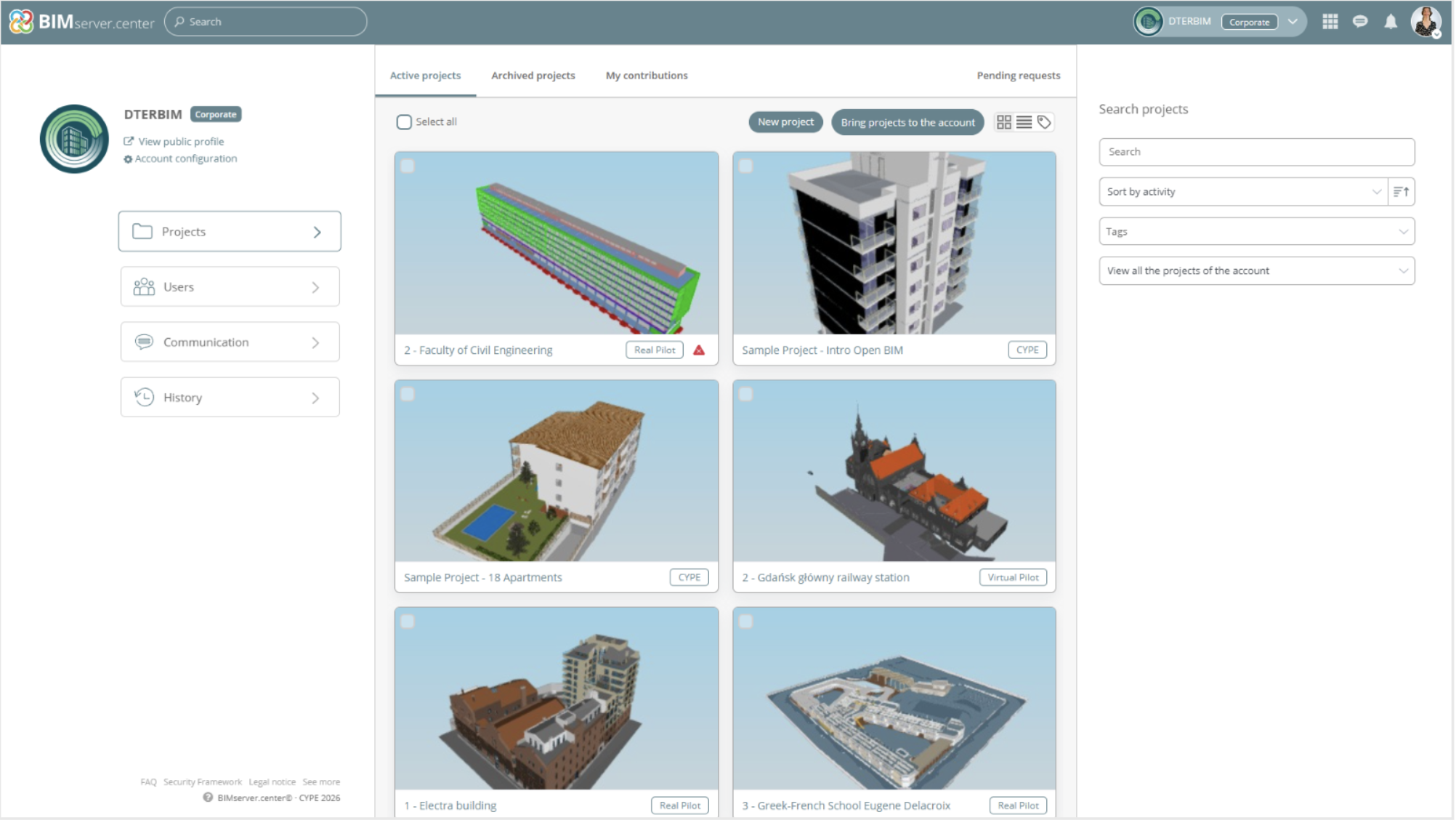
As our work has just started, these first months have been focused on preparing the groundwork for the activities ahead. One of our key priorities has been to ensure that pilot partners share their project information through the BIMserver.center platform and make it accessible to all project partners, enabling a transparent and collaborative environment.
To support this, a dedicated collaborative account has been created in BIMserver.center for DTERBIM, where all partners can work together, share information, and access project data. Roles and permissions have been defined and assigned to ensure that each participant can contribute efficiently while maintaining proper data management and control.
Looking ahead, what impact do you hope DTERBIM will have on the construction sector?
I believe the most significant impact of DTERBIM is its potential to improve how data is managed and shared across the construction sector. By enabling interoperability and integrating dynamic and static data, the project can help reduce inefficiencies, minimise errors, and support better decision-making.
“I believe the most significant impact of DTERBIM is its potential to improve how data is managed and shared across the construction sector.”
This is the third in a series of interviews with DTERBIM partners, highlighting the people, expertise, and innovations driving the project forward.
Want to meet more of the experts behind DTERBIM? Follow us on LinkedIn, Bluesky, X, and YouTube, and subscribe to our newsletter for future interviews and project updates.