

Building the future: Celebrating the women driving innovation in DTERBIM
Innovation thrives on diversity. International Women's Day 2026 reminds us that building more inclusive industries is not just a matter of fairness; it is essential for progress. In construction, women represent only 10% of the workforce in Europe, with even lower representation in technical and leadership roles. In STEM fields, women comprise just 34% of graduates across the EU, and in artificial intelligence (AI), only 22% of professionals are women. These are not just statistics. They represent missed perspectives, untapped talent and innovation left unrealised.
At DTERBIM, we are working to change that narrative. Our mission to develop an open, interoperable BIM-based ecosystem powered by AI and Digital Twins sits at the intersection of construction, technology, and sustainability, sectors where diverse perspectives are essential.
Research consistently shows that diverse teams produce more innovative solutions, make better decisions, and deliver stronger results. The European Commission's work on gender equality in research and innovation demonstrates that when women participate fully in STEM fields, entire industries benefit from fresh perspectives, creative problem-solving, and more inclusive design thinking.
This International Women’s Day, we are spotlighting six women from the DTERBIM consortium who are helping shape the future of digital construction. Their stories highlight both the progress being made and the work that still lies ahead to achieve greater gender balance in the field. We asked them about their role in DTERBIM, their career journeys, what motivates them despite the challenges in the sector, how projects like DTERBIM can help create a more inclusive ecosystem, and the advice they would give to future generations.
Meet the women shaping DTERBIM
Across our team, women are contributing to DTERBIM from different disciplines, from architecture and engineering to research, innovation management, and digital technology. Here are six of the professionals helping drive the project forward.
Ane Ferreiro Sistiaga (CYPE)
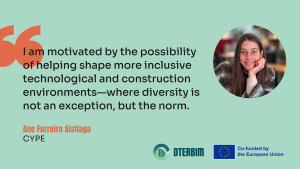
An architect at CYPE's Development Department, Ane contributes to DTERBIM by providing a BIM project management platform that connects with various tools and services throughout a project's lifecycle. "Our role is to enable interoperability and coordination among multiple software solutions within an open BIM ecosystem. The objective is to create a collaborative digital environment where different tools can exchange information during both project design and long-term asset management.
What excites me most about DTERBIM is precisely this collaboration between different software companies. It gives us a direct understanding of the real needs and challenges professionals face when working in a connected digital environment. Contributing to the creation of an open and useful collaborative framework—where interoperability is not just theoretical but practical—is extremely motivating. It is about shaping how digital workflows in architecture, engineering, and construction (AEC) can become more efficient and integrated."
Sonia Álvarez Díaz (CARTIF)
Sonia brings expertise in BIM-based modelling, energy simulation, and digital interoperability. "In addition to my technical contributions, I'm the Project Coordinator of DTERBIM, which is both a major responsibility and a motivating challenge. My role is to guide the project toward its objectives while fostering strong collaboration among its 18 partners."
Elzbieta Borun (Contecht GmbH)
CEO at Contecht, Elzbieta participates as a technical partner providing software solutions for the Digital Twin and BIM environment. "My role focuses on administrative management and internal coordination on our side, ensuring structured processes, clear documentation, and effective collaboration within the consortium.
What excites me most is contributing to a Digital Twin ecosystem where software, structured data, and BIM methodologies come together to enable smarter infrastructure management and long-term sustainability."
Carmen Alonso del Caño (CARTIF)
From CARTIF's R&D Programmes Department, Carmen coordinates the administrative and financial aspects to ensure the project runs smoothly. "We act as the main interface with the European Commission, ensuring partners' compliance, consolidating reporting, and monitoring progress to ensure milestones are met and payments are released.
What excites me most about DTERBIM is having a strategic, cross-project view, working with diverse international partners, and the satisfaction of helping complex research collaborations translate into real impact."
Gloria Calleja-Rodríguez (CEMOSA)
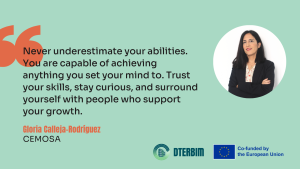
Research & Innovation Deputy Director at CEMOSA, Gloria leads the team responsible for developing the Building Digital Twin and Sustainable Twin, the application for smart quality control, and the pilot preparation and data collection. "My role involves coordinating the technical strategy, guiding the development of digital tools, and ensuring their integration supports sustainability and efficient asset management while adding value to CEMOSA engineering services.
What excites me most is the opportunity to merge cutting-edge digital technologies with real-world engineering processes to create solutions that transform traditional engineering services towards sustainability and digitalisation."
María Romero López (Geoter)
Head of R&D&I at Geoter, María is involved in the research, sizing, and installation of the geothermal system (boreholes and heat pump) for the Spanish DTERBIM pilot, and collaborates on the project's BIM developments, "an area in which I have a lot to learn, and I believe will be very positive for our company."
What inspired their career paths
Their journeys into architecture, engineering, research and innovation were shaped by curiosity, passion for technology, and a desire to contribute to a more sustainable built environment.
Ane has been working in architecture linked to BIM and software development for the AEC sector since 2018:
"I chose architecture because it uniquely combines artistic sensibility with technical rigour. Since I was young, I was fascinated by visiting buildings while travelling—understanding how spaces shape experience and how technical decisions influence aesthetics and functionality. Architecture allowed me to bring together creativity, structural logic, environmental performance, and social impact.
Regarding software development for architecture and engineering, I often say that it chose me. I have always been deeply interested in new technologies. Architects, perhaps more than many other professionals, use an extraordinary variety of digital tools in daily practice: office software, 3D modelling platforms, rendering engines, energy simulation tools, structural calculation software, image editing programs such as Photoshop, and many others. This constant interaction with diverse technologies gives architects a unique perspective on usability, interoperability, and workflow integration. That perspective naturally led me toward working in software development for the built environment."
Sonia found her path through an early interest in technical subjects and creativity:
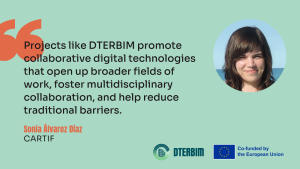
"From a young age, I was interested in technical drawing, technology, and mathematics, and when the time came to choose my studies, I decided to pursue Architecture because I saw it as a field combining technical knowledge with creativity. Over time, my interests shifted towards digital technologies and research, a direction reinforced by my Master's degree in Technologies for the Protection of Immovable Cultural Heritage, where I worked with GIS applied to heritage conservation and started working with BIM.
Later, I combined my work as a researcher at CARTIF in the field of energy efficiency with my PhD in Architecture, focused on the use of BIM and advanced digital technologies for building renovation, which allowed me to integrate architecture, digital innovation, and sustainability into my career."
Carmen chose a career in administration for its strategic impact:
"My field is administration, and I chose to work in it because I am interested in optimising processes, coordinating resources, and supporting strategic decision-making within organisations. I am motivated by contributing to projects running efficiently and sustainably, combining analysis, planning, and people management. Additionally, it is a versatile field that allows adaptation to different sectors and professional challenges."
Gloria was drawn to engineering through a combination of passion, purpose and curiosity:
"My career choice was shaped by a combination of three key factors:
- A strong passion for technical subjects: I've always enjoyed mathematics, physics, and technology.
- A desire to contribute to sustainability: I wanted to apply this technical knowledge to improve how we design, build, and maintain our world, making it more sustainable.
- A wish for continuous learning: research and innovation allow me to explore new ideas, solve complex problems, and avoid routine. No two days are ever the same.
María pursued engineering driven by her interest in renewable energy:
"I work in the area of geothermal research, and I chose to study an engineering degree related to energy due to my strong interest in renewable energies."
Facing gender imbalance and staying motivated
Ane reflects on the gender imbalance she has observed throughout her career and the progress she has witnessed in European projects:
"When I studied architecture, the number of male and female graduates was already balanced. However, in professional practice—especially in construction—the environment remains predominantly male. Many of the most internationally recognised architecture studios are still led by men. During my studies, female architects were rarely presented as references, and their contributions were often overshadowed.
For that reason, I collaborated with the platform Un día | Una arquitecta, whose goal is to publish biographies of women architects and make their work visible online. I also helped place posters around the school highlighting major female architects whose contributions had often been hidden or attributed to male figures. Visibility matters: representation shapes ambition.
In software development, the gender imbalance is even more striking. It can be intimidating to enter a field where women are still significantly underrepresented. There is still a strong collective perception that technology and programming are predominantly male domains. If you look at gender statistics in technical university degrees, the imbalance is evident and concerning. We are, in many ways, leaving one of the most critical fields for defining our technological future largely in male hands.
I clearly remember my first European projects around 2018. In meeting rooms of 20 people, there might have been only two women—if that. It was impactful and, at times, made me feel 'lucky' just to be there. Over time, however, I have seen positive change. European gender equality policies have contributed to increasing female participation, and DTERBIM itself reflects that progress.
"European gender equality policies have contributed to increasing female participation, and DTERBIM itself reflects that progress."
What keeps me motivated is precisely the awareness that representation matters. Being present, contributing technically, and participating in decision-making spaces is already part of the change. I am motivated by the possibility of helping shape more inclusive technological and construction environments—where diversity is not an exception, but the norm."
María also shares an honest perspective on the barriers women still face in the sector, while recognising the progress being made:
"I believe that it is harder for us as women to get to do tasks that are considered 'men's work' because society doesn't assume that we should do them. We have to show more motivation than men to go to construction sites, do fieldwork, etc. And it is more difficult to reach high-level positions in the company because power has been historically associated with men. However, in my day-to-day life with my colleagues, I don't feel there is any inequality, and I am treated very well by everyone. I am motivated because we are making progress step by step and aiming higher and higher."
"I am motivated because we are making progress step by step and aiming higher and higher."
How digital innovation creates inclusive environments
Beyond individual experiences, digital transformation itself is helping reshape the culture of the AEC sector.
Sonia highlights how DTERBIM itself demonstrates the potential for change:
"Projects like DTERBIM promote the adoption of collaborative digital technologies in the construction sector, an approach that opens up broader fields of work, fosters multidisciplinary collaboration, and helps reduce traditional barriers by integrating diverse expertise and professional profiles.
Our multidisciplinary team at CARTIF, contributing to the DTERBIM project, reflects this evolution. It is predominantly composed of women with strong expertise in energy efficiency, combining backgrounds in architecture and engineering with advanced knowledge of BIM and artificial intelligence. This illustrates how digital innovation can naturally foster more diverse and inclusive professional environments."
Advice for the next generation of women in innovation
Elzbieta offers reassurance about a universal experience:
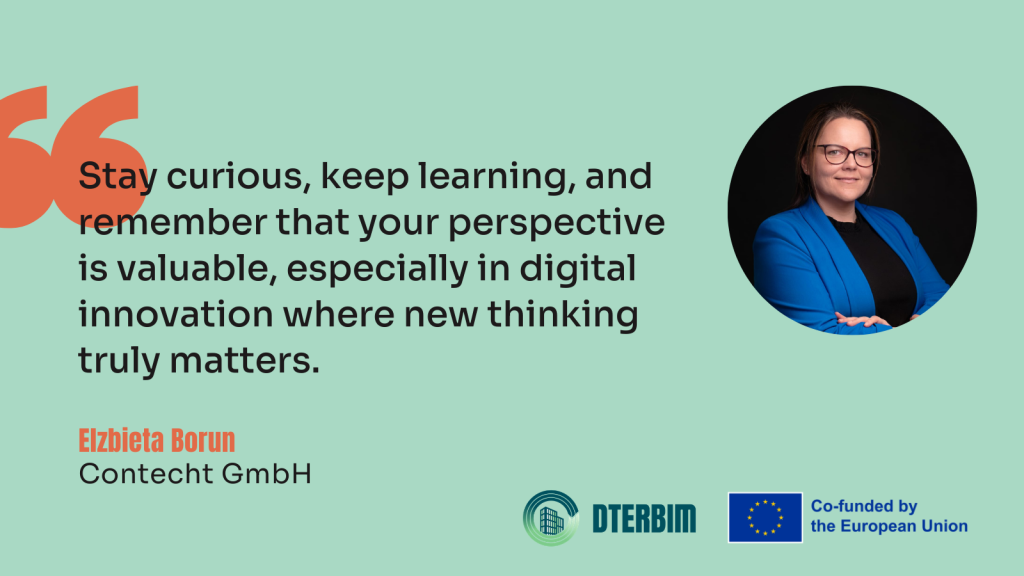
"You will probably doubt yourself at some point—that's normal. Don't let it stop you. Stay curious, keep learning, and remember that your perspective is valuable, especially in digital innovation where new thinking truly matters."
Carmen emphasises the importance of community and confidence:
"My advice to young women considering a career in administration is to embrace leadership opportunities confidently, seek continuous learning, and actively participate in projects that challenge the current situation. Most importantly, support and network with other women, helping to strengthen our presence and influence in specialised fields traditionally related to men."
Gloria gives a powerful message of self-belief:
"Never underestimate your abilities. You are capable of achieving anything you set your mind to. Trust your skills, stay curious, and surround yourself with people who support your growth."
Building a more inclusive future
The interviewees' experiences in this article highlight both the challenges and the opportunities ahead. They speak to persistent barriers—from underrepresentation in meeting rooms to the difficulty of accessing what is still predominantly considered as “men’s work”—but also to tangible progress: more balanced European project teams, multidisciplinary environments where women lead technical innovation, and a growing recognition that diversity drives better outcomes.
The European Union's commitment to gender equality in research and innovation has created structural support for change. Horizon Europe requires gender balance in project teams and gender considerations in research design. These policies are working: participation of women in EU-funded research has increased steadily, and projects like DTERBIM benefit from that progress.
But policy alone isn't enough. As Ane notes, “Visibility matters: representation shapes ambition.” When young women see female architects, engineers, and technology leaders doing groundbreaking work, they can imagine themselves in those roles. When hiring managers actively seek diverse candidates, teams become stronger, and when organisations create inclusive cultures, talent thrives.
DTERBIM's work—building open, interoperable digital systems for sustainable construction—depends on diverse perspectives. The challenges we face in decarbonising Europe's building stock, improving energy efficiency, and creating circular renovation processes are complex. They require technical excellence, creative problem-solving, and an understanding of how buildings serve different communities. That work is better when everyone can collaborate as equals.
This International Women's Day, we celebrate the women of DTERBIM and commit to continuing the work of building a construction industry and digital innovation ecosystem where everyone can contribute fully. Because the future we are building—one where data becomes insight and insight becomes action—requires the talents and voices of everyone.
About DTERBIM
DTERBIM is a Horizon Europe project developing an open, interoperable BIM-based ecosystem powered by AI and Digital Twins to accelerate Europe's transition to circular, energy-efficient building renovation. The consortium brings together 18 partners across Europe working to create user-friendly digital tools, open standards, and validated solutions demonstrated through pilots in Spain, Poland, and Greece.
For more updates and stories on DTERBIM, subscribe to our newsletter and follow us on LinkedIn, Bluesky, X, and YouTube.
