
Sonia Álvarez Díaz, DTERBIM Project Coordinator (CARTIF): "My focus is on turning the DTERBIM vision into practical digital tools that support better decision-making during the design and construction phases"
In our previous interview with Sonia Álvarez Díaz, architect and researcher at CARTIF Technology Centre, as part of our #DTERBIMVoices series, we explored her background, her work with digital technologies for the built environment, and what keeps her motivated. In this second conversation, we take a closer look at Sonia’s role within DTERBIM, both as Project Coordinator and as leader of Work Package 4 (WP4), "Digital tools for efficient, circular and sustainable Design & Construction".
She shares what CARTIF is developing within the project, the progress made so far, and her vision for how DTERBIM could contribute to more interoperable, standardised and data-driven workflows across the construction and renovation sector.
Let's zoom in on your role within DTERBIM. What is your team responsible for? What challenge are you addressing?
Within DTERBIM, CARTIF is responsible for developing several of the digital tools that will support the DTERBIM process. This includes the BIM upgrading and enrichment tool, as well as the development of a Digital Building Logbook and the standardisation of the data handover process.
As WP4 Leader, my focus is on turning the DTERBIM vision into practical digital tools that support better decision-making during the design and construction phases. The main challenge we are addressing is how to move from fragmented, poorly connected design and construction workflows to more interoperable, data-driven, and circular processes. WP4 is also important because some of the tools developed within this work package will be among the first DTERBIM solutions to be tested and validated in the real demo sites.
"The main challenge we are addressing is how to move from fragmented and poorly connected design and construction workflows towards more interoperable, data-driven and circular processes."
What has your team achieved so far? And what are your main goals for the next phase of the project?
Regarding WP4, CARTIF has so far progressed in defining the data model for the digital catalogue of Energy Conservation Measures, aligned with the Smart Readiness Indicator and circularity principles. This is an important first step because the catalogue will provide a structured basis for connecting renovation measures with other digital tools developed within the project.
In the next phase, our main goal is to continue developing this catalogue and its connection with other tools, such as the early design tool led by ICCS and the BIM upgrading and enrichment tool developed by CARTIF. These developments are expected to help improve the quality of BIM models and support better decision-making from the early design stages.
These are the most immediate results expected in this work package over the coming months.
In your view, what is the most significant impact DTERBIM could have on the construction sector? What changes would you like to see as a result of your work on the project?
From the WP4 perspective, I believe that one of the most significant impacts of DTERBIM could be to help the sector move towards more interoperable, standardised, and data-driven workflows from the early design and construction phases.
I would like our work to help ensure that BIM information, circularity criteria, material traceability, and enriched digital models are used in a more practical way to support informed decisions throughout the renovation process.
"I would like our work to help ensure that BIM information, circularity criteria, material traceability, and enriched digital models are used in a more practical way to support informed decisions throughout the renovation process."
This is the seventh in a series of interviews with DTERBIM partners, highlighting the people, stories, and ideas driving the project forward.
Want to meet more of the experts behind DTERBIM? Follow us on LinkedIn, Bluesky, X, and YouTube, and subscribe to our newsletter for future interviews and project updates.

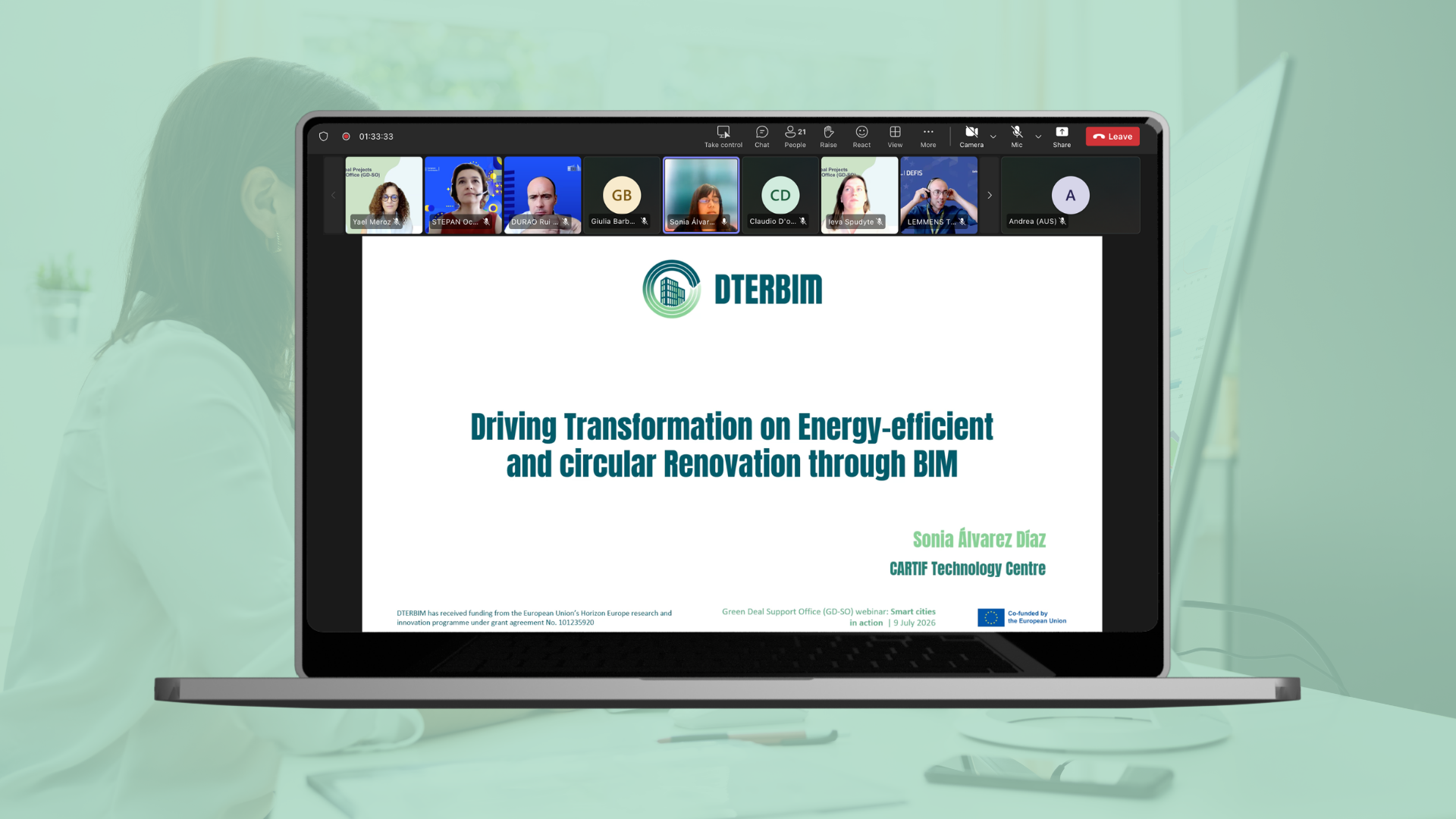
DTERBIM joins Green Deal webinar on Digital Twins, AI, and urban climate resilience
On 9 July 2026, we had the opportunity to present DTERBIM at the webinar "Smart Cities in Action: Digital Twins, Real-time Data, AI, and Mobility for Urban Climate Resilience", organised by the Green Deal Projects Support Office (GD-SO). Our coordinator, Sonia Álvarez (CARTIF), joined representatives from other Horizon Europe, Green Deal, and Horizon 2020 projects, as well as European institutions, to discuss how advanced digital solutions are helping shape smarter, greener, and more resilient cities and address some of today's most pressing urban challenges. EU Green Deal Call, Horizon 2020, and Horizon Europe.
Speakers explored how Digital Twins, Artificial Intelligence (AI), and advanced data management can support more sustainable neighbourhood planning, greenhouse gas monitoring, airport decarbonisation, and energy-efficient building renovation.
The discussion also addressed broader challenges, including data interoperability, system integration, usability for public authorities, and the policy and funding landscape needed to accelerate the adoption of these technologies, in line with EU priorities on climate-neutral cities, sustainable mobility, and environmental data sharing.
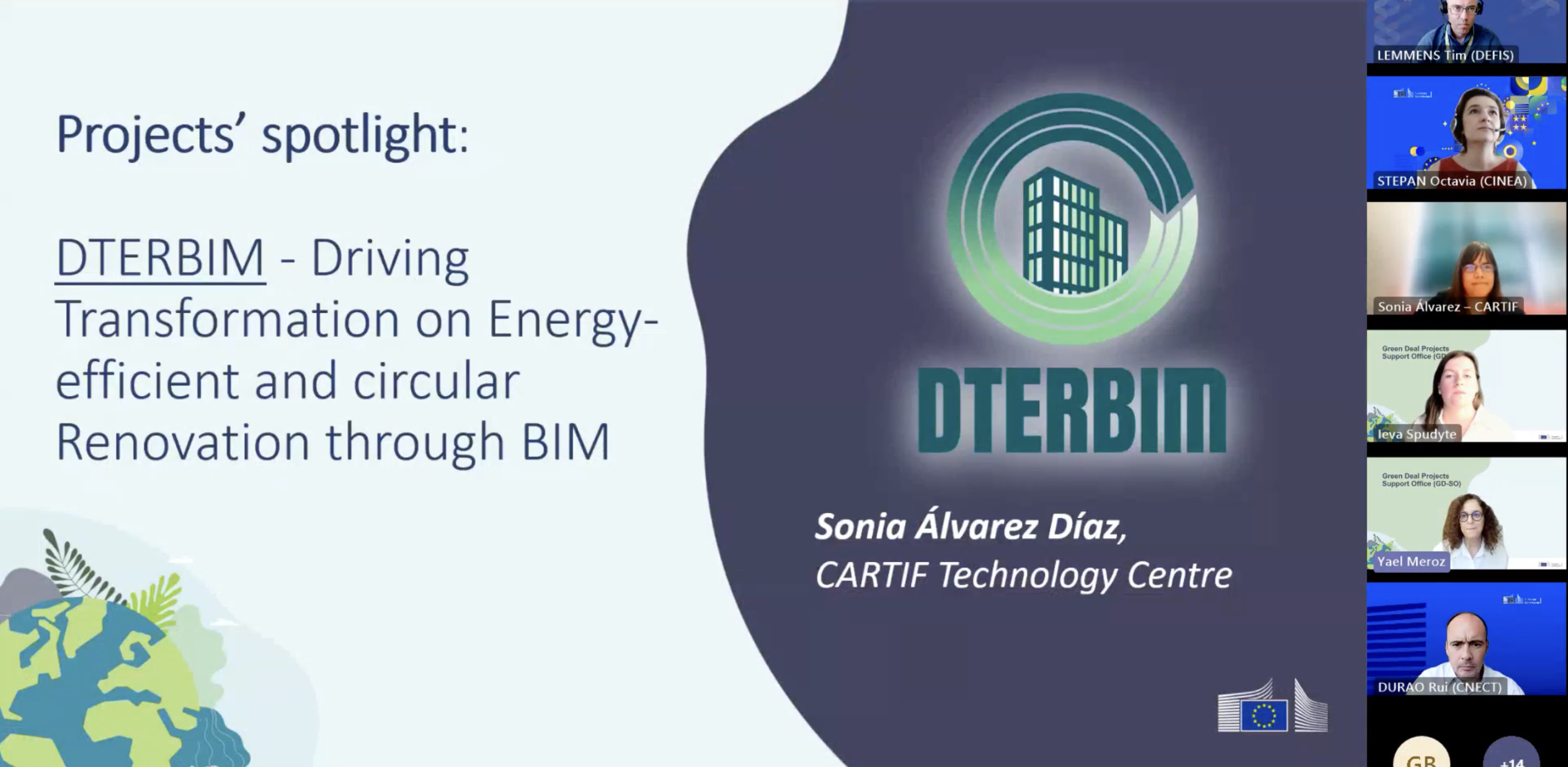
Sonia Álvarez Díaz, DTERBIM's Coordinator and researcher at CARTIF Technology Centre, presented DTERBIM alongside PROBONO, ICOS Cities-PAUL, and STARGATE, highlighting the approaches these projects are taking to support Europe's transition towards climate-neutral cities.
Sonia explained that we are developing an openBIM-based methodology and digital toolkit to support energy-efficient and circular renovation. In particular, she highlighted how we are combining technologies such as Building Information Modelling (BIM), Digital Twins, and AI to improve collaboration, optimise decision-making, and support more sustainable building renovation throughout the entire building lifecycle.
Watch the webinar and download the PPT slides
If you missed the live session or would like to revisit it, you can watch the recording and access the presentation slides below:
https://www.youtube.com/watch?v=cr5aMopXTcg
Thank you to GD-SO for hosting such an insightful discussion and to all speakers for sharing their knowledge!
Subscribe to our newsletter for future updates and follow us on LinkedIn, Bluesky, X, and YouTube.

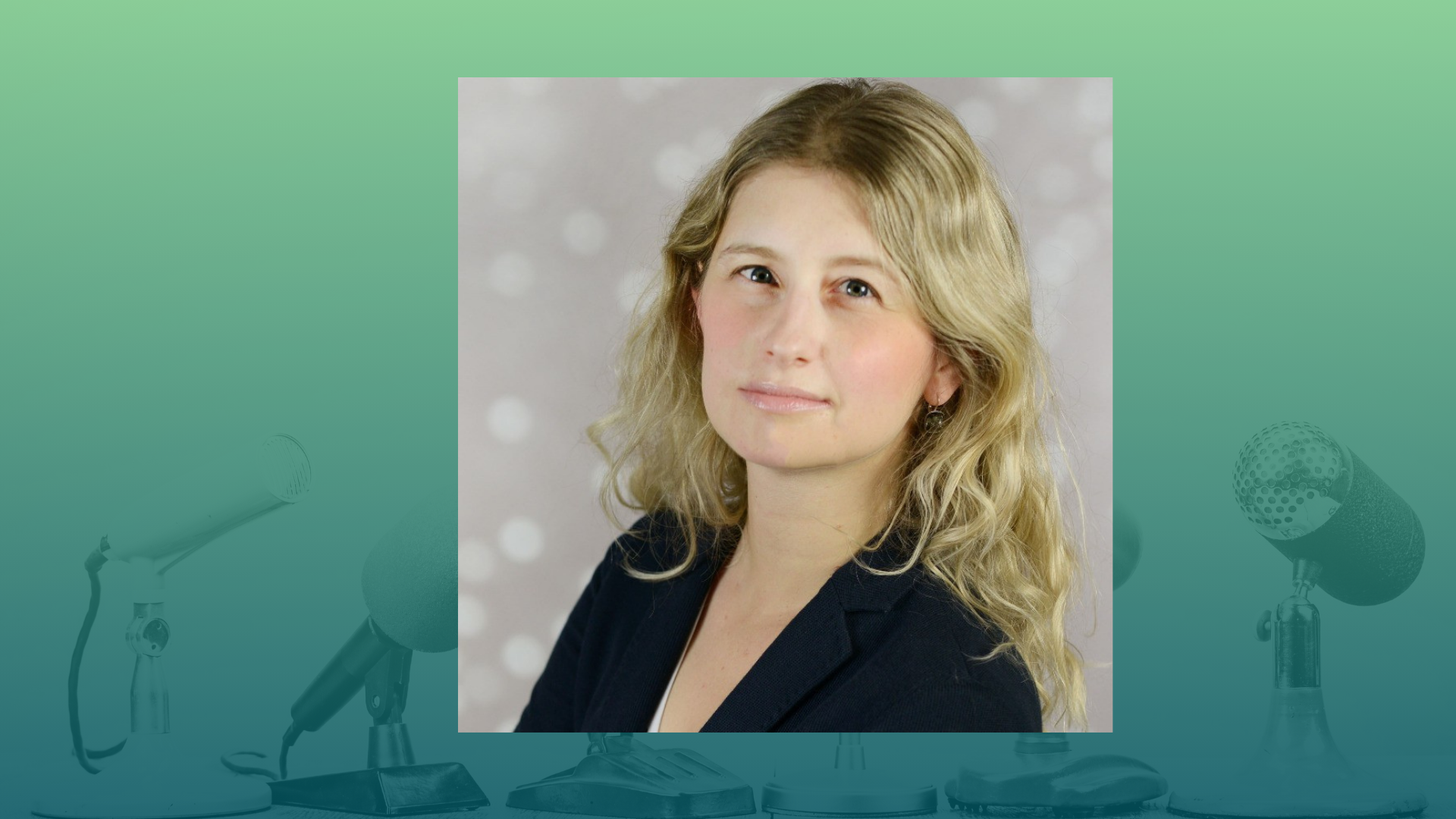
Agnieszka Łukaszewska (FASADA): "DTERBIM has the potential to make advanced digital tools and BIM-based solutions more accessible and practical"
Developing digital tools is one thing. Making sure they work in the complex, changing reality of a construction site is another. In this edition of #DTERBIMVoices, we speak with Agnieszka Łukaszewska, Head of R&D at FASADA, the partner leading DTERBIM's demonstration and validation activities across our three pilot sites in Poland, Spain, and Greece.
Agnieszka shares her perspective on the role of digitalisation in construction, the challenges of testing innovative solutions in real-world environments, and how closer collaboration between technology developers and construction professionals can help turn digital innovation into practical impact.
Could you briefly introduce yourself? What is your background, and what work do you focus on currently?
I am the Head of R&D at FASADA. I am a civil engineer with expertise in the implementation of digital processes in construction, as well as in the management of research and innovation projects.
FASADA is an SME that has been active on the market for more than 25 years. On one side, we carry out construction and renovation works for both public and private clients, and on the other, we support our clients in understanding how digital solutions can positively impact construction processes and project management. Our goal is to help clients deliver construction and renovation projects that are better adapted to their needs, while also responding to changing social, environmental, and market requirements.
"Our goal is to help clients deliver construction and renovation projects that are better adapted to their needs, while also responding to changing social, environmental, and market requirements."
What do you enjoy most about your work? What keeps you motivated?
What I enjoy most about my work is the opportunity to engage with new and interesting topics every day through research activities. It allows me to observe how a traditionally conservative sector like construction is evolving and adapting to new technologies and innovative solutions.
As someone deeply connected to the construction and renovation industry, I see myself as a bridge between emerging technologies and everyday construction practice. I find it especially motivating to observe how digitalisation is transforming the reality of the construction sector and creating new opportunities for efficiency and sustainability.
"As someone deeply connected to the construction and renovation industry, I see myself as a bridge between emerging technologies and everyday construction practice."
Now let's zoom in on your role within DTERBIM. What is your team responsible for? What challenge are you addressing?
FASADA is the leader of the demonstration and validation activities. This means that we are responsible for coordinating and managing the validation process of various DTERBIM tools across three demonstration buildings located in Poland, Spain, and Greece, representing different geographical conditions and construction practices.
Demonstration activities are at the core of the project and represent one of its biggest challenges, as we test innovative developments in real construction environments. Unlike laboratory conditions, construction sites are dynamic and complex, which makes the implementation and validation process much more demanding.
"Unlike laboratory conditions, construction sites are dynamic and complex, which makes the implementation and validation process much more demanding."
Another important aspect of our work is close collaboration with professionals on construction and renovation sites who are not typically involved in research projects. For this reason, it is essential that DTERBIM solutions are developed from the very beginning in close cooperation with the demonstration projects, taking into account the practical requirements, needs, and realities of everyday construction work.
What has your team achieved so far? And what are your main goals for the next phase of the project?
So far, our team has successfully established a strong connection between the technology developers and the construction sites involved in the project. We are currently gathering and aligning the requirements and practical needs of the demonstration sites to ensure that the developed solutions respond to real construction and renovation challenges.
An important part of our work has also been collecting and analysing the available data for the demonstration buildings, including geometry data, information about materials, existing BIM models, and other technical documentation. Based on this analysis, we are identifying what additional data and inputs are necessary for the effective implementation and validation of the DTERBIM solutions.
In the next phase of the project, our main goal is to further support the integration and testing of the developed technologies in real construction environments. We want to ensure that the solutions are practical, user-friendly, and adaptable to different building conditions, construction practices, and stakeholder needs across the three demonstration sites.
"We want to ensure that the solutions are practical, user-friendly, and adaptable to different building conditions, construction practices, and stakeholder needs across the three demonstration sites."
In your view, what is the most significant impact DTERBIM could have on the construction sector? What changes would you like to see as a result of your work on the project?
I believe the most significant impact of DTERBIM could be accelerating the digital transformation of the construction and renovation sector. The project has the potential to make advanced digital tools and BIM-based solutions more accessible and practical for everyday use on construction sites, not only for researchers or technology experts.
"The project has the potential to make advanced digital tools and BIM-based solutions more accessible and practical for everyday use on construction sites, not only for researchers or technology experts."
Through our work, I would like to see strong collaboration between technology developers and construction professionals, as well as greater openness within the sector toward innovation and data-driven decision-making. I also hope that the project will contribute to more efficient, sustainable, and better-managed renovation processes, helping the industry adapt to future environmental and technological challenges.
This is the fifth in a series of interviews with DTERBIM partners, highlighting the people, stories, and ideas driving the project forward.
Want to meet more of the experts behind DTERBIM? Follow us on LinkedIn, Bluesky, X, and YouTube, and subscribe to our newsletter for future interviews and project updates.
Sonia Álvarez Díaz, DTERBIM Project Coordinator at CARTIF: "One of the greatest impacts of DTERBIM will be to demonstrate how digitalisation can transform the way we design, renovate and manage buildings"
Delivering a Horizon Europe project goes far beyond developing innovative technologies. It also means bringing together partners with different areas of expertise, aligning technical and strategic objectives, and ensuring that research translates into practical solutions. In this edition of our #DTERBIMVoices series, we speak with Sonia Álvarez Díaz, Project Coordinator of DTERBIM and researcher at CARTIF Technology Centre. With a background in architecture, Sonia shares what motivates her and why collaboration is key to driving the digital and circular transformation of Europe's construction sector.
To begin, could you tell us a little about yourself? What is your background, and what does your work at CARTIF focus on today?
I am Sonia Álvarez Díaz, an architect and researcher in the Energy Division of CARTIF Technology Centre, within the Energy Efficiency Area. I hold a PhD in Architecture, focused on the use of BIM and advanced digital technologies for energy-efficient building renovation projects, as well as a Master’s degree in Technologies for the Protection of Immovable Cultural Heritage.
My current work focuses mainly on the application of digital technologies to energy efficiency management, building and urban renovation, and semantic 3D modeling through GIS and BIM technologies, as well as their connection with Digital Twins.
What aspects of your work do you find most rewarding? What continues to inspire and motivate you?
What I enjoy most is the variety of topics I work on, mainly related to the use of digital technologies in the built environment to improve energy efficiency, from building scale to city scale. I also value the more practical side of my work, such as on-site data collection for building digitalisation and energy audits, as well as the development of decarbonisation plans and energy improvement strategies. This keeps me closely connected to real buildings and real challenges.
What keeps me motivated is learning. I really enjoy learning about new topics, proposing new ideas, and applying them in both proposals and real projects.
"What keeps me motivated is learning. I really enjoy learning about new topics, proposing new ideas, and applying them both in proposals and in real projects."
As DTERBIM's Project Coordinator, what are your main responsibilities? What challenges are you addressing?
Within DTERBIM, I have several responsibilities. My main role is as Project Coordinator, but I am also involved in the technical development of the project. As Project Coordinator, my focus is on ensuring that all technical, organisational, and strategic elements of DTERBIM move in the same direction. I would say this is one of the main challenges of the project.
"As Project Coordinator, my focus is on ensuring that all technical, organisational and strategic elements of DTERBIM move in the same direction."
Looking at the first months of the project, what have been the main achievements? And what priorities lie ahead?
From a coordination perspective, starting a European project always requires a significant effort in terms of management, administration, and technical alignment. During these first months, we have focused on setting up the project structure, supporting the consortium, clarifying initial questions, and addressing the first issues that naturally arise in a project involving 18 partners and three real demonstration sites.
One of the closest objectives at the project level is to have the first definition of the BIM-based renovation and new construction processes across the complete building lifecycle. This will be a collaborative process, based on the analysis of stakeholders' needs, barriers, and challenges in business-as-usual circular and energy renovation practices. This participatory approach is essential to ensure that the solutions developed in DTERBIM are relevant, scalable, interoperable, and useful for the sector.
What impact do you hope DTERBIM will have on the construction sector?
At the general project level, I believe one of the greatest impacts of DTERBIM will be to demonstrate how digitalisation can transform the way we design, renovate, and manage buildings, integrating circularity to achieve more efficient and sustainable processes.
"One of the greatest impacts of DTERBIM will be to demonstrate how digitalisation can transform the way we design, renovate, and manage buildings, integrating circularity to achieve more efficient and sustainable processes."
As a result of our work, I would like to see the Architecture, Engineering, and Construction (AEC) sector move towards a more innovative, sustainable and connected model, where Small and medium-sized enterprises (SMEs) in particular can engage more easily with a collaborative digital ecosystem through the DTERBIM Toolkit and its accessible, cost-effective, and easy-to-use digital solutions.
"I would like to see the AEC sector move towards a more innovative, sustainable and connected model, where SMEs can engage more easily with a collaborative digital ecosystem through the DTERBIM Toolkit."
This is the fourth in a series of interviews with DTERBIM partners, highlighting the people, stories, and ideas driving the project forward.
Want to meet more of the experts behind DTERBIM? Follow us on LinkedIn, Bluesky, X, and YouTube, and subscribe to our newsletter for future interviews and project updates.
Read Sonia Álvarez's second interview, where she expands on her role within DTERBIM, both as Project Coordinator and as the leader of Work Package 4 (WP4), “Digital tools for efficient, circular and sustainable Design & Construction”:
https://dterbim.eu/sonia-alvarez-diaz-project-coordinator-dterbim-interview/