
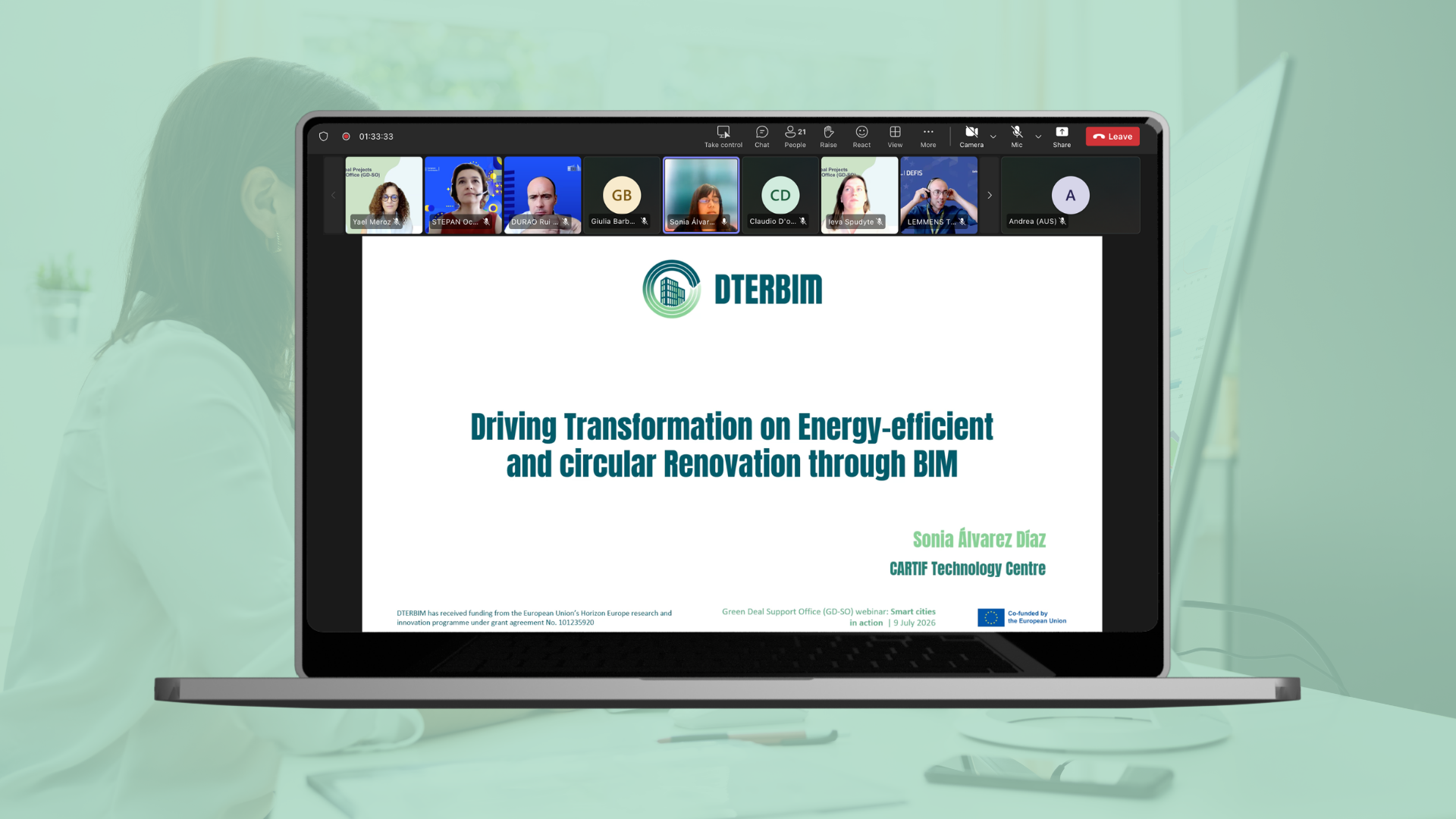
DTERBIM joins Green Deal webinar on Digital Twins, AI, and urban climate resilience
On 9 July 2026, we had the opportunity to present DTERBIM at the webinar "Smart Cities in Action: Digital Twins, Real-time Data, AI, and Mobility for Urban Climate Resilience", organised by the Green Deal Projects Support Office (GD-SO). Our coordinator, Sonia Álvarez (CARTIF), joined representatives from other Horizon Europe, Green Deal, and Horizon 2020 projects, as well as European institutions, to discuss how advanced digital solutions are helping shape smarter, greener, and more resilient cities and address some of today's most pressing urban challenges. EU Green Deal Call, Horizon 2020, and Horizon Europe.
Speakers explored how Digital Twins, Artificial Intelligence (AI), and advanced data management can support more sustainable neighbourhood planning, greenhouse gas monitoring, airport decarbonisation, and energy-efficient building renovation.
The discussion also addressed broader challenges, including data interoperability, system integration, usability for public authorities, and the policy and funding landscape needed to accelerate the adoption of these technologies, in line with EU priorities on climate-neutral cities, sustainable mobility, and environmental data sharing.
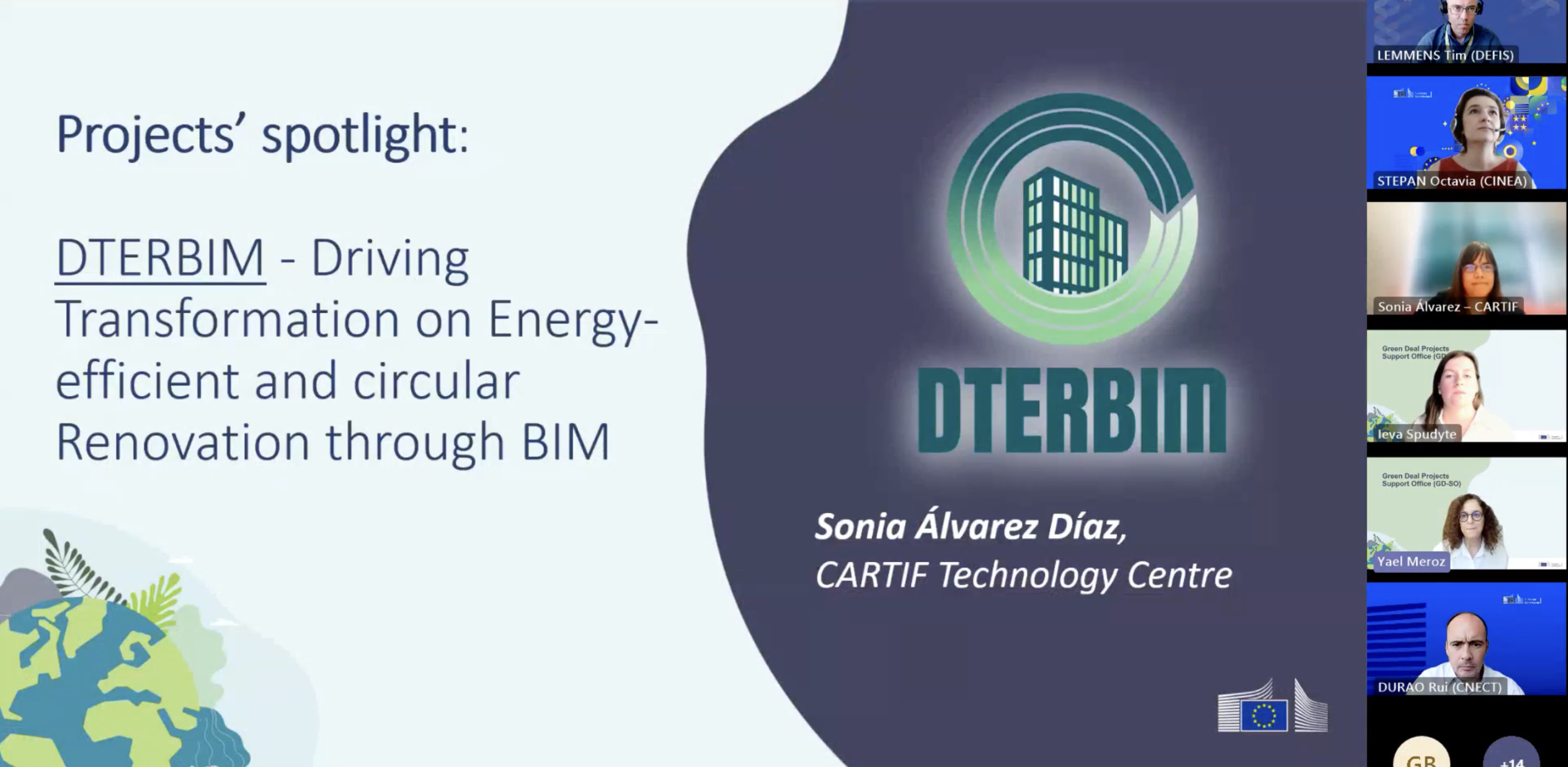
Sonia Álvarez Díaz, DTERBIM's Coordinator and researcher at CARTIF Technology Centre, presented DTERBIM alongside PROBONO, ICOS Cities-PAUL, and STARGATE, highlighting the approaches these projects are taking to support Europe's transition towards climate-neutral cities.
Sonia explained that we are developing an openBIM-based methodology and digital toolkit to support energy-efficient and circular renovation. In particular, she highlighted how we are combining technologies such as Building Information Modelling (BIM), Digital Twins, and AI to improve collaboration, optimise decision-making, and support more sustainable building renovation throughout the entire building lifecycle.
Watch the webinar and download the PPT slides
If you missed the live session or would like to revisit it, you can watch the recording and access the presentation slides below:
https://www.youtube.com/watch?v=cr5aMopXTcg
Thank you to GD-SO for hosting such an insightful discussion and to all speakers for sharing their knowledge!
Subscribe to our newsletter for future updates and follow us on LinkedIn, Bluesky, X, and YouTube.

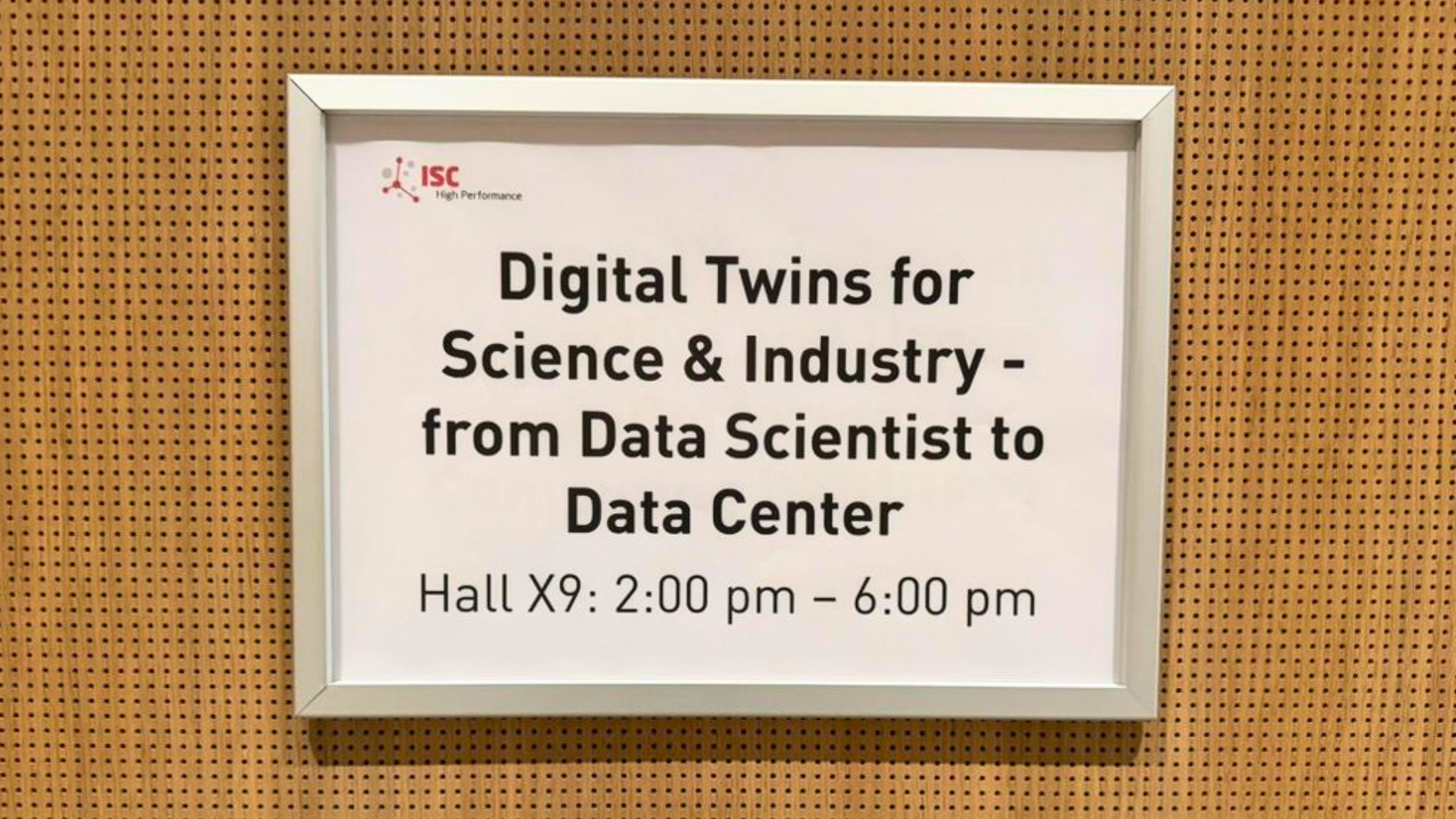
DTERBIM presented at ISC 2026 workshop on Digital Twins and AI
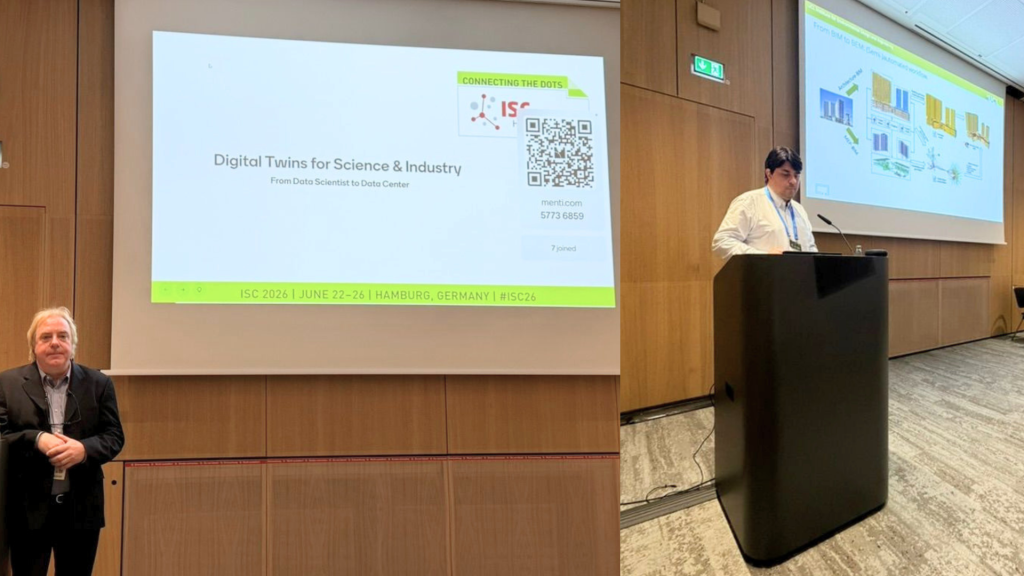
On 26 June 2026, DTERBIM was represented at the workshop "Digital Twins for Science & Industry: From Data Scientist to Data Center", held as part of ISC High Performance 2026 in Hamburg, Germany.
During the workshop, Dimitrios Rovas, Professor of Building Simulation and Optimization at University College London (UCL), delivered the presentation "The Building of the Future: Digital Building Twins and AI Agents for Smart Operations."
His talk explored how Digital Building Twins and AI can support smarter building operation and management, contributing to the digital transformation of the built environment. The workshop brought together participants from academia, industry, research centres, startups, and SMEs.
Learn more about the workshop on the official event website.
Subscribe to our newsletter for future updates, visit our website, and follow us on LinkedIn, Bluesky, X, and YouTube.
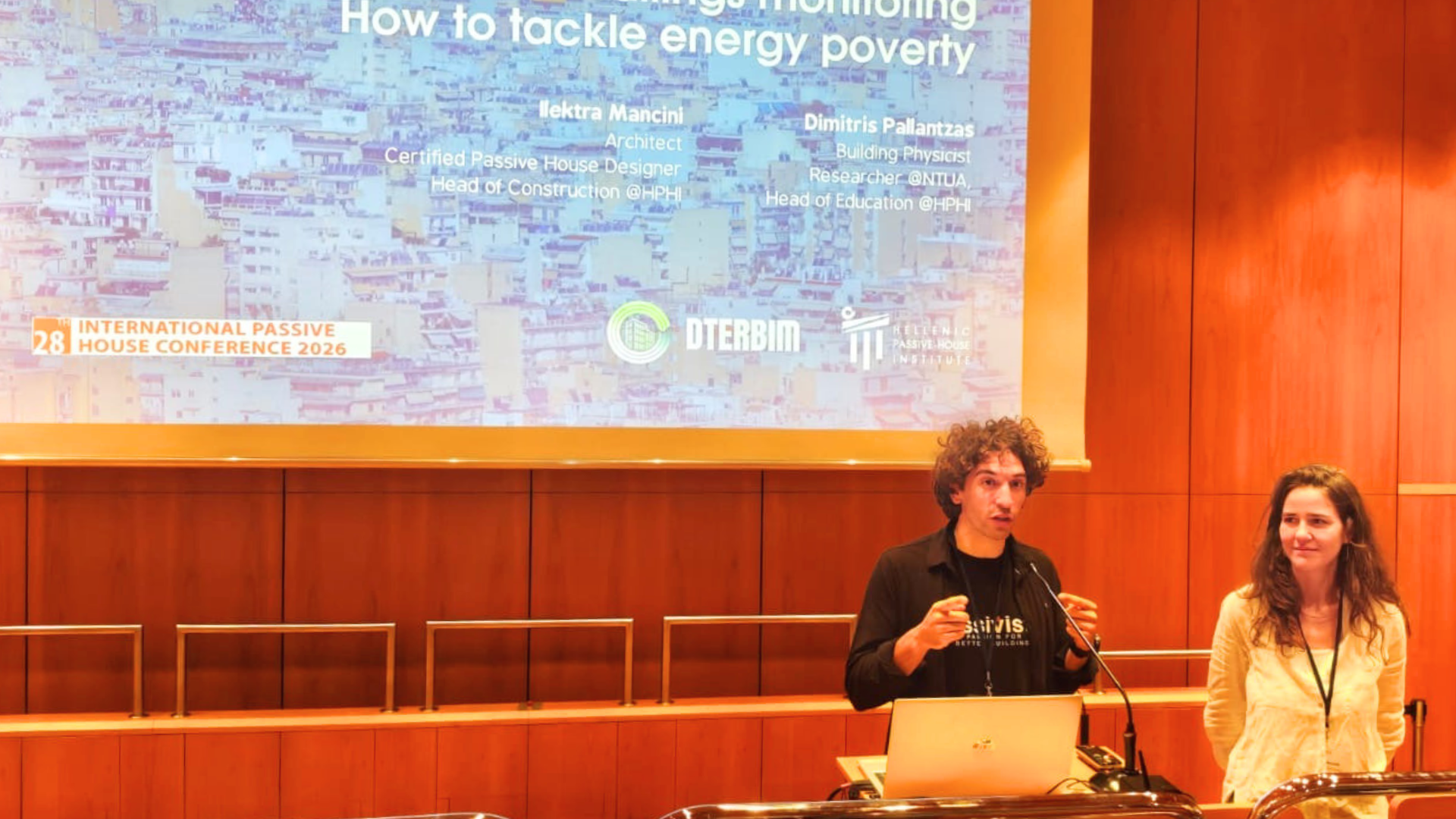
DTERBIM at the 28th International Passive House Conference
DTERBIM partner Hellenic Passive House Institute (HPHI) took to the stage at the 28th International Passive House Conference, where researchers Ilektra Mancini and Dimitris Pallantzas presented HPHI's study on energy poverty in metropolitan cities.
The ongoing research combines district energy and comfort simulations with extensive fieldwork, including questionnaires, monitoring, energy studies, and thermography, across more than 100 buildings in Greece. The aim is to calibrate digital modelling with real-time data to build a more accurate picture of how energy poverty manifests at the urban scale.
At DTERBIM, we will play a key role in the next stages of this research. Our early design and assessment tools, together with our BIM models, will provide guidance to decision-makers and policymakers.
Here is the presentation that Ilektra Mancini and Dimitris Pallantzas delivered at the event: "District-level solutions: From modelling to 100 buildings monitoring - How to tackle energy poverty".
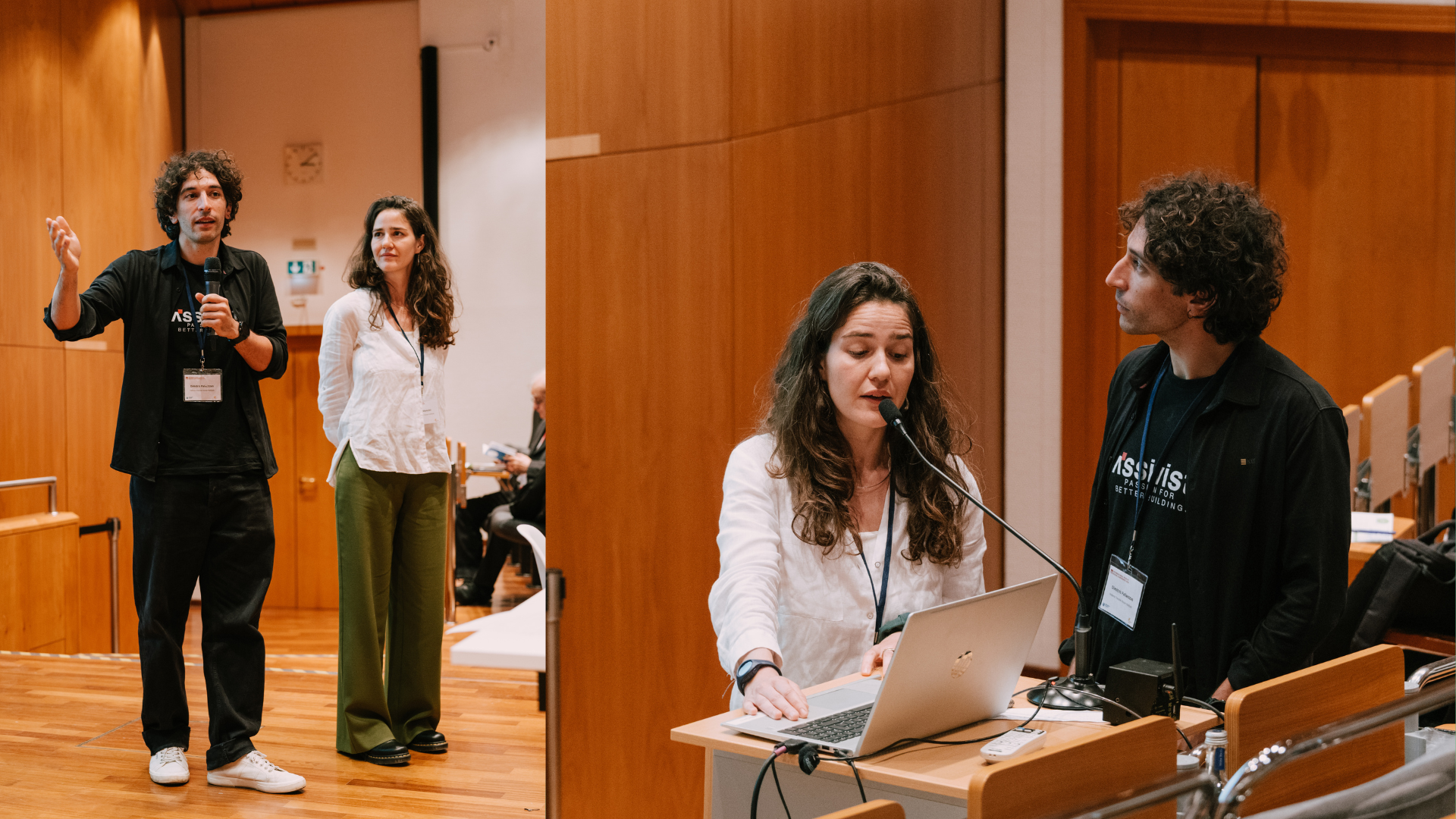
About the Hellenic Passive House Institute
The Hellenic Passive House Institute supports stakeholders across the building sector and the wider public by providing impartial, comprehensive information on the design and implementation of Passivhaus buildings.
Its activities include producing informational materials, conducting seminars and scientific research, and certifying completed Passivhaus projects. HPHI also delivers advanced training, supports the design and construction of new and existing buildings, and actively contributes to national and EU policy dialogue, promoting energy efficiency as a cornerstone of climate action.
In DTERBIM, HPHI leads the Greek pilot in Pallini, Athens, which will house a kindergarten and an elementary school, both designed and built as certified Passivhaus and Positive Energy Buildings.
Working closely with Greek partners Urban Soul Project and SmartFlex, HPHI bridges digital design and real-world construction by integrating BIM and Passive House methodologies. Under its coordination, approximately 80% of the pilot's design will be developed through BIM and DTERBIM digital tools. HPHI also contributes to the development of our Early Design Tool, supporting data-driven design optimisation and digital innovation for educational buildings.
Sign up for our newsletter to receive updates, visit our website, and follow us on LinkedIn, Bluesky, X, and YouTube.