
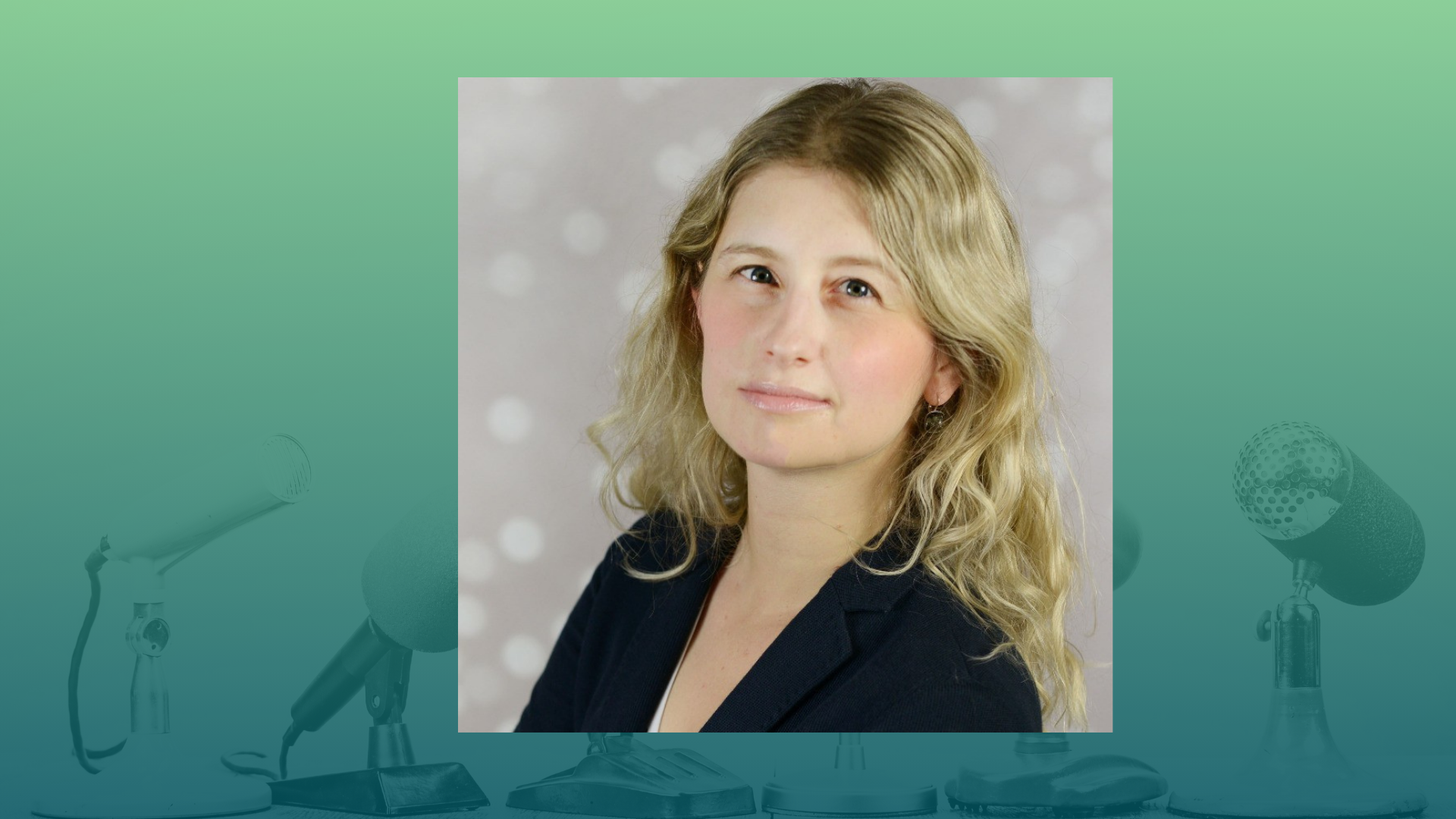
Agnieszka Łukaszewska (FASADA): "DTERBIM has the potential to make advanced digital tools and BIM-based solutions more accessible and practical"
Developing digital tools is one thing. Making sure they work in the complex, changing reality of a construction site is another. In this edition of #DTERBIMVoices, we speak with Agnieszka Łukaszewska, Head of R&D at FASADA, the partner leading DTERBIM's demonstration and validation activities across our three pilot sites in Poland, Spain, and Greece.
Agnieszka shares her perspective on the role of digitalisation in construction, the challenges of testing innovative solutions in real-world environments, and how closer collaboration between technology developers and construction professionals can help turn digital innovation into practical impact.

Could you briefly introduce yourself? What is your background, and what work do you focus on currently?
I am the Head of R&D at FASADA. I am a civil engineer with expertise in the implementation of digital processes in construction, as well as in the management of research and innovation projects.
FASADA is an SME that has been active on the market for more than 25 years. On one side, we carry out construction and renovation works for both public and private clients, and on the other, we support our clients in understanding how digital solutions can positively impact construction processes and project management. Our goal is to help clients deliver construction and renovation projects that are better adapted to their needs, while also responding to changing social, environmental, and market requirements.
"Our goal is to help clients deliver construction and renovation projects that are better adapted to their needs, while also responding to changing social, environmental, and market requirements."
What do you enjoy most about your work? What keeps you motivated?
What I enjoy most about my work is the opportunity to engage with new and interesting topics every day through research activities. It allows me to observe how a traditionally conservative sector like construction is evolving and adapting to new technologies and innovative solutions.
As someone deeply connected to the construction and renovation industry, I see myself as a bridge between emerging technologies and everyday construction practice. I find it especially motivating to observe how digitalisation is transforming the reality of the construction sector and creating new opportunities for efficiency and sustainability.
"As someone deeply connected to the construction and renovation industry, I see myself as a bridge between emerging technologies and everyday construction practice."
Now let's zoom in on your role within DTERBIM. What is your team responsible for? What challenge are you addressing?
FASADA is the leader of the demonstration and validation activities. This means that we are responsible for coordinating and managing the validation process of various DTERBIM tools across three demonstration buildings located in Poland, Spain, and Greece, representing different geographical conditions and construction practices.
Demonstration activities are at the core of the project and represent one of its biggest challenges, as we test innovative developments in real construction environments. Unlike laboratory conditions, construction sites are dynamic and complex, which makes the implementation and validation process much more demanding.
"Unlike laboratory conditions, construction sites are dynamic and complex, which makes the implementation and validation process much more demanding."
Another important aspect of our work is close collaboration with professionals on construction and renovation sites who are not typically involved in research projects. For this reason, it is essential that DTERBIM solutions are developed from the very beginning in close cooperation with the demonstration projects, taking into account the practical requirements, needs, and realities of everyday construction work.
What has your team achieved so far? And what are your main goals for the next phase of the project?
So far, our team has successfully established a strong connection between the technology developers and the construction sites involved in the project. We are currently gathering and aligning the requirements and practical needs of the demonstration sites to ensure that the developed solutions respond to real construction and renovation challenges.
An important part of our work has also been collecting and analysing the available data for the demonstration buildings, including geometry data, information about materials, existing BIM models, and other technical documentation. Based on this analysis, we are identifying what additional data and inputs are necessary for the effective implementation and validation of the DTERBIM solutions.
In the next phase of the project, our main goal is to further support the integration and testing of the developed technologies in real construction environments. We want to ensure that the solutions are practical, user-friendly, and adaptable to different building conditions, construction practices, and stakeholder needs across the three demonstration sites.
"We want to ensure that the solutions are practical, user-friendly, and adaptable to different building conditions, construction practices, and stakeholder needs across the three demonstration sites."
In your view, what is the most significant impact DTERBIM could have on the construction sector? What changes would you like to see as a result of your work on the project?
I believe the most significant impact of DTERBIM could be accelerating the digital transformation of the construction and renovation sector. The project has the potential to make advanced digital tools and BIM-based solutions more accessible and practical for everyday use on construction sites, not only for researchers or technology experts.
"The project has the potential to make advanced digital tools and BIM-based solutions more accessible and practical for everyday use on construction sites, not only for researchers or technology experts."
Through our work, I would like to see strong collaboration between technology developers and construction professionals, as well as greater openness within the sector toward innovation and data-driven decision-making. I also hope that the project will contribute to more efficient, sustainable, and better-managed renovation processes, helping the industry adapt to future environmental and technological challenges.
This is the fifth in a series of interviews with DTERBIM partners, highlighting the people, stories, and ideas driving the project forward.
Want to meet more of the experts behind DTERBIM? Follow us on LinkedIn, Bluesky, X, and YouTube, and subscribe to our newsletter for future interviews and project updates.

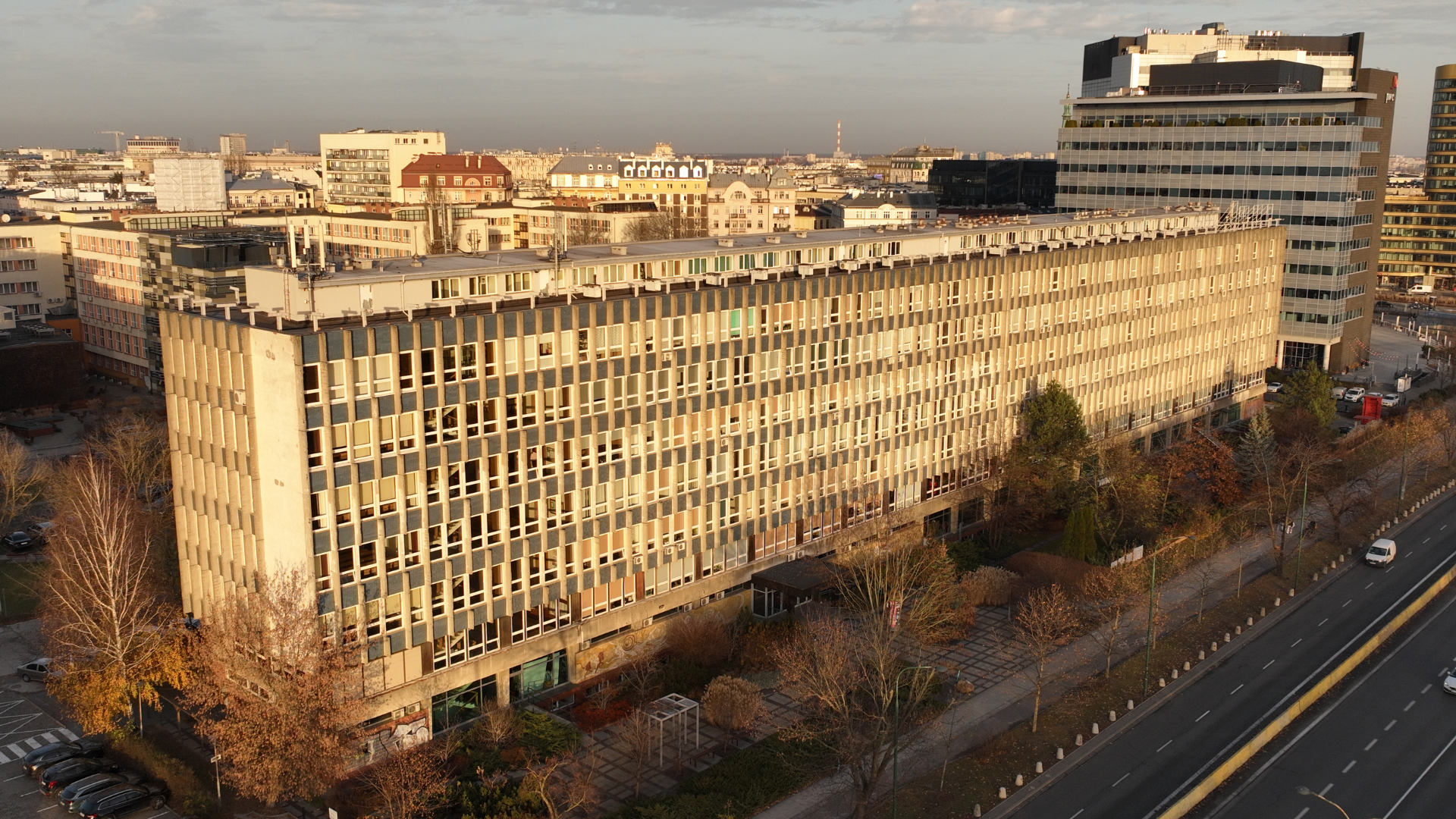
DTERBIM pilots: A look at data collection in Warsaw
Behind every Digital Twin, BIM model, and AI-powered tool lies a key ingredient: high-quality data. At the DTERBIM Polish pilot site, our team has been capturing and processing detailed data that will serve as the foundation for the digital models used throughout the project.
The building in question is the Faculty of Civil Engineering at Warsaw University of Technology. Built between 1970 and 1976 and located in the heart of Warsaw, the facility is scheduled for revitalisation and extension works due to its current condition. This makes it an ideal case study for demonstrating how digital technologies can support complex, real-world renovation challenges.
How is it all coming together? To showcase the process, we have created a series of short videos. Here is what you will discover:
Building scanning
The building selected for this pilot had no reliable as-built documentation available. Before any renovation works can begin, an accurate digital record of the existing structure is needed, which is what this scanning provides.
This video presents the data collection process at the Warsaw University of Technology, one of our three real-life demonstration pilots. It combines an aerial drone perspective with a detailed walkthrough of how geospatial data is captured using the NavVis VLX scanner, one of the most advanced handheld scanning tools available. Through this 3D laser-scanning, we captured the geometry of the building spaces, façades, and structural elements and turned them into a point cloud.
The video also shows how we then processed the point cloud. This processed point cloud becomes the foundation for an accurate BIM model of the existing building — the starting point for planning renovation works.
https://www.youtube.com/watch?v=HRBaE_SDf7I
Data collection on site
A closer look at the full range of data collection methods used on site: 360° photographic documentation, site walks, NavVis MLX and VLX scanning, and drone-based photogrammetry. We imported all the data we collected into the Dalux platform, making it accessible on both desktop and mobile.
https://www.youtube.com/watch?v=tnujYS33oqs
Point cloud and BIM model creation
This video shows how the raw scan data is turned into actionable information. Using drone and scanner outputs, we generated a detailed point cloud of the building and its surroundings, including the building's characteristic concrete fins. Internal scanning provides precise room layouts, which serve as the basis for developing the BIM model.
https://www.youtube.com/watch?v=ADLOnFpx_lI
Collecting and integrating data on the Dalux platform
This video focuses on how all the collected data comes together on the Dalux platform. From 360° photos and site walks to point cloud comparison and IFC model filtering, Dalux provides us with intuitive access to a rich, layered digital record of the building.
https://www.youtube.com/watch?v=I95wl9pmliM
The work we are carrying out in Warsaw is a great example of how accurate, detailed, and well-organised data can support digital renovation processes. By creating a reliable digital foundation, we are ensuring that renovation decisions are better informed, more efficient, and aligned with circularity and sustainability goals.
The collected data will also be used by the Warsaw University of Technology as training materials for students, future engineers who form the foundation of the construction industry.
Watch all videos on our YouTube channel and stay tuned for more updates as we continue advancing our pilot activities!
Subscribe to our newsletter for future updates, and follow us on LinkedIn, Bluesky, X, and YouTube.
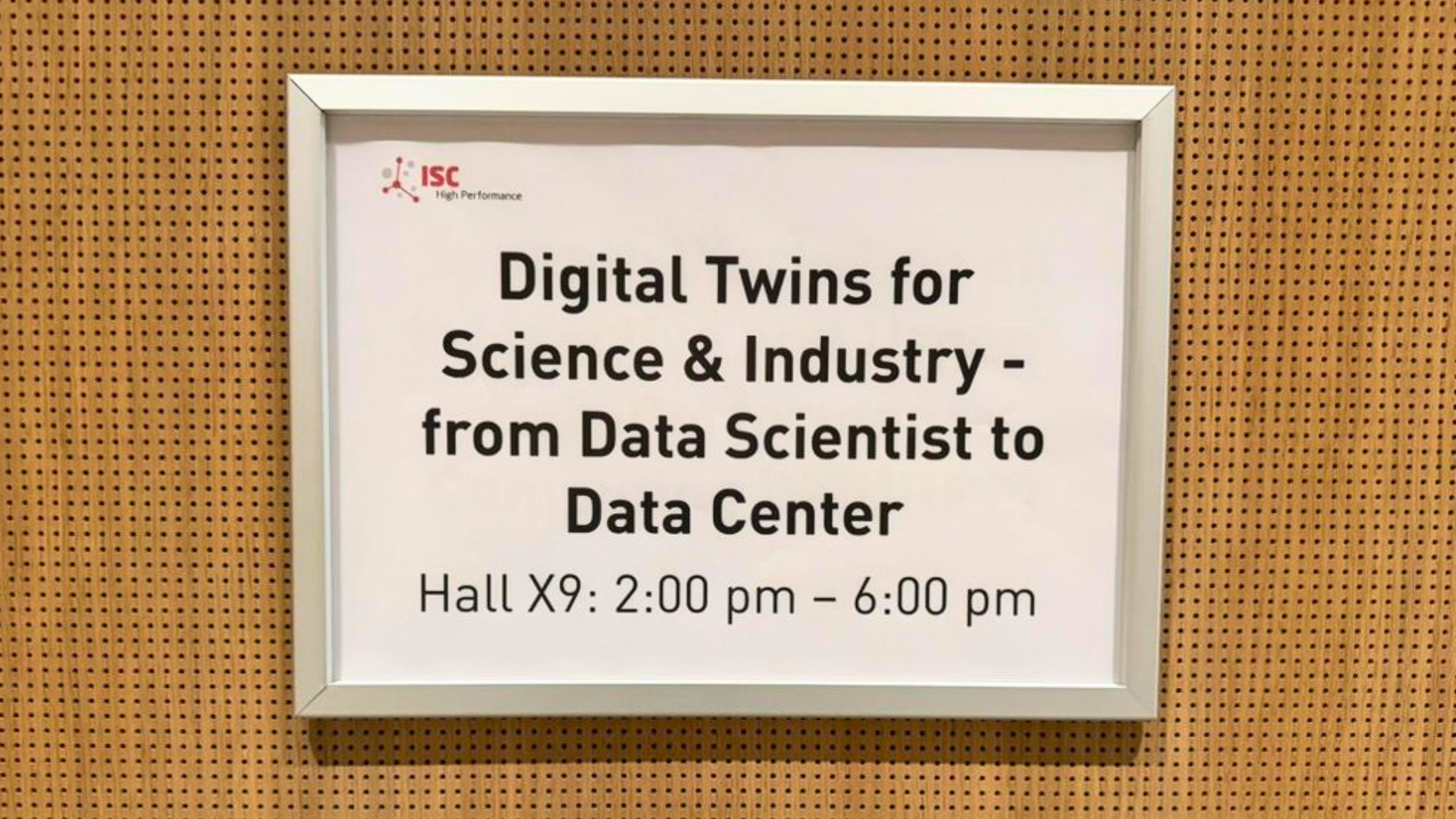
DTERBIM presented at ISC 2026 workshop on Digital Twins and AI
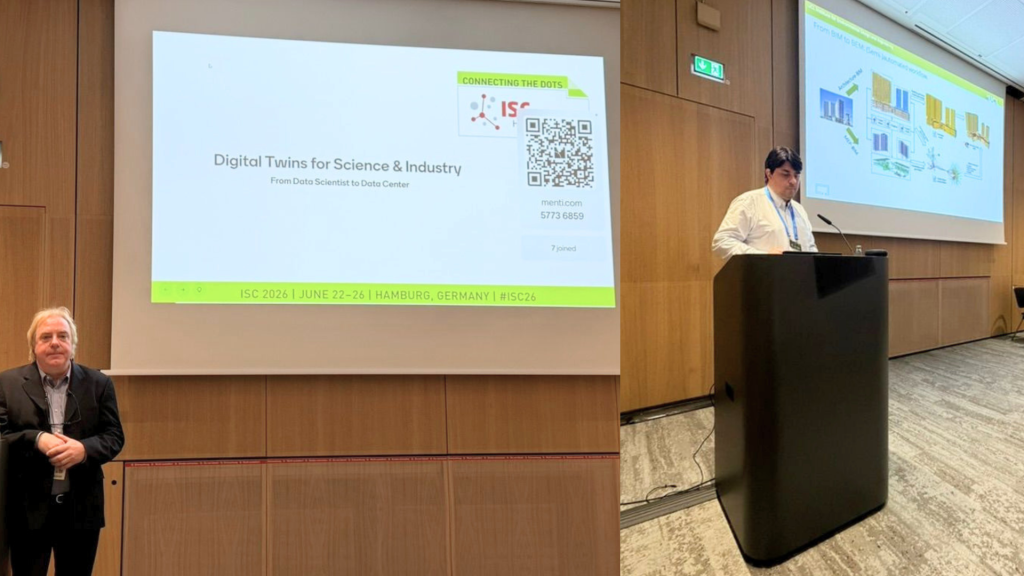
On 26 June 2026, DTERBIM was represented at the workshop "Digital Twins for Science & Industry: From Data Scientist to Data Center", held as part of ISC High Performance 2026 in Hamburg, Germany.
During the workshop, Dimitrios Rovas, Professor of Building Simulation and Optimization at University College London (UCL), delivered the presentation "The Building of the Future: Digital Building Twins and AI Agents for Smart Operations."
His talk explored how Digital Building Twins and AI can support smarter building operation and management, contributing to the digital transformation of the built environment. The workshop brought together participants from academia, industry, research centres, startups, and SMEs.
Learn more about the workshop on the official event website.
Subscribe to our newsletter for future updates, visit our website, and follow us on LinkedIn, Bluesky, X, and YouTube.

DTERBIM Newsletter #3: DTERBIM Voices, latest updates, and upcoming opportunities
The third edition of the DTERBIM newsletter includes our most recent milestones, partner activities, upcoming events, and selected news from across the digital, circular, and energy-efficient construction sector.
What’s inside this third edition?
This newsletter features the launch of DTERBIM Voices, our new interview series highlighting the people, expertise, and ideas driving our work forward. The first interviews feature Dimitrios Rovas (University College London) and Stathis Stamatopoulos (ICCS/NTUA), who share how their teams are contributing to the development of solutions for smarter building renovation.
It also contains updates from our partners, highlights from our first periodic meeting in Brussels, details of upcoming events, such as the webinar on 9 July, where our coordinator, Sonia Álvarez (CARTIF), will present our work and discuss how Digital Twins and AI can help build more climate-resilient cities, and a curated selection of insightful resources on construction innovation.
Read the DTERBIM newsletter #3
Subscribe for future updates, visit our website, and follow us on LinkedIn, Bluesky, X, and YouTube.

DTERBIM Newsletter #2: Women driving innovation, project updates, and pilot insights
The second edition of the DTERBIM newsletter is now available, bringing together the latest updates and insights from across the project. In this issue, we spotlight the women driving innovation at DTERBIM, share recent progress, and introduce how our pilots are advancing digital and circular renovation across Europe.
What’s inside this second edition?
The newsletter features the stories of six women from DTERBIM who are contributing to transforming the construction innovation sector. They reflect on their career paths, the challenges of working in traditionally underrepresented fields, and the importance of diversity in driving innovation.
It also highlights recent developments, from our Tools & Services Workshop, where we reviewed the full suite of DTERBIM tools and defined the use cases guiding the upcoming validation phase, to our feature on the cover of Materiały Budowlane, showcasing one of our pilot buildings in Poland.
The edition introduces our Brand Book, designed to ensure consistent and effective communication about the project, and our pilots, where we are validating our approach both virtually and through three real-life demonstrations in Spain, Poland, and Greece.
It also includes a selection of events and resources on digital twins, AI, and construction innovation, helping readers stay up to date with the trends shaping the sector.
Read the DTERBIM newsletter #2
Subscribe for future updates, visit our website, and follow us on LinkedIn, Bluesky, X, and YouTube.
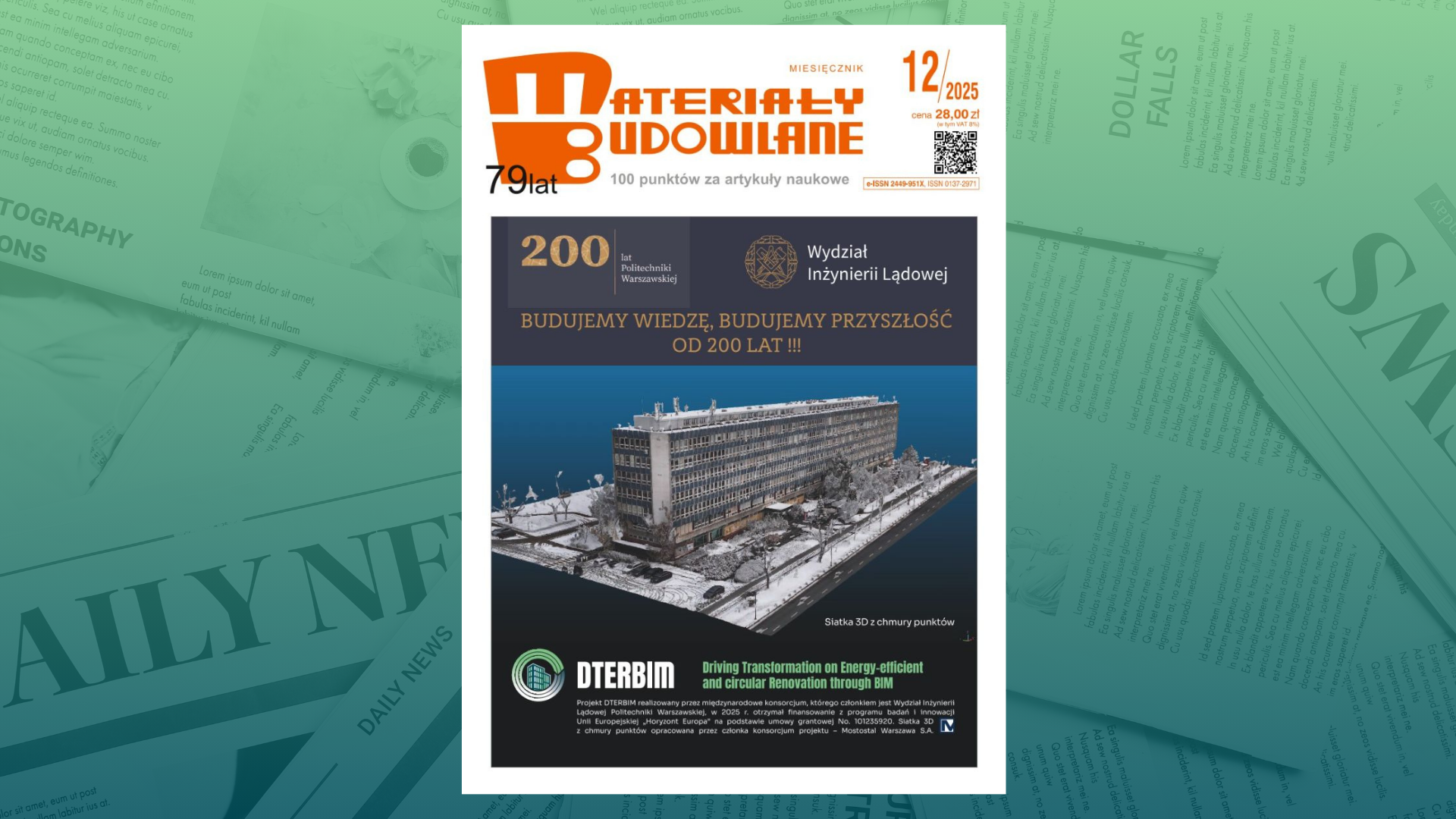
DTERBIM featured on the cover of Materiały Budowlane journal
DTERBIM appears on the cover of the December 2025 issue of Materiały Budowlane, a prestigious Polish journal for the construction industry! This special edition celebrates the 200th anniversary of the Faculty of Civil Engineering at the Warsaw University of Technology, one of DTERBIM's pilot sites in Poland.
The cover showcases a 3D mesh generated from a point cloud of the Faculty building, created by our partner Mostostal Warszawa S.A. This digital representation demonstrates the type of innovative work DTERBIM brings to building renovation: transforming physical structures into precise digital models that enable smarter planning, collaboration, and sustainable outcomes.
The feature highlights how DTERBIM's Digital Twin approach is being applied to real buildings across Europe, supporting the renovation of diverse structures with advanced digital tools.
About DTERBIM
DTERBIM is a Horizon Europe project developing an open, interoperable BIM-based ecosystem powered by AI and Digital Twins to accelerate Europe's transition to circular, energy-efficient building renovation. The consortium brings together 18 partners across Europe working to create user-friendly digital tools, open standards, and validated solutions demonstrated through pilots in Spain, Poland, and Greece.
For more updates and stories on DTERBIM, visit our website, subscribe to our newsletter, and follow us on LinkedIn, Bluesky, X, and YouTube.
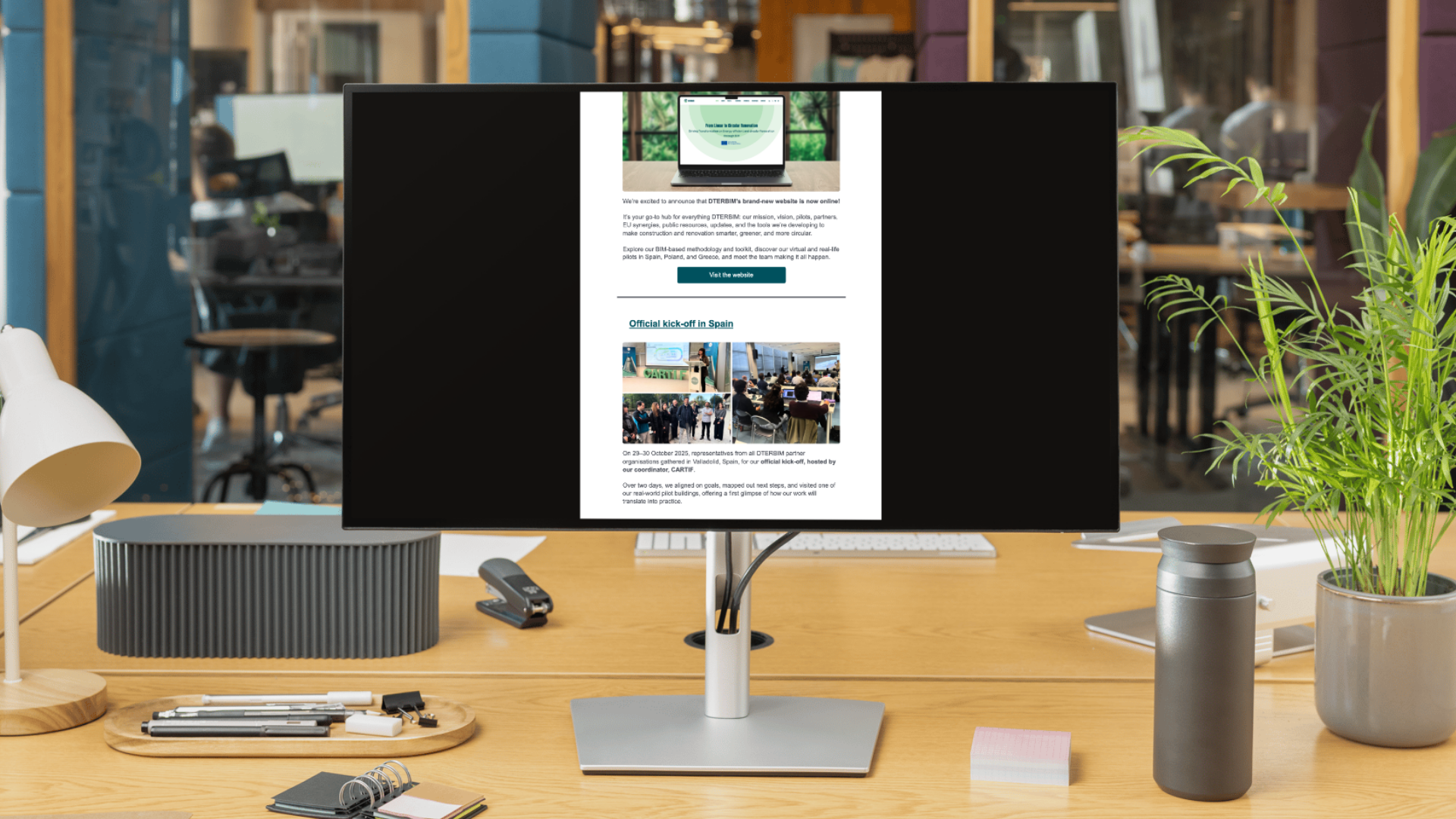
DTERBIM Newsletter #1: A look at our first milestones
We are pleased to share the first edition of the DTERBIM newsletter, marking an important milestone as the project officially gets underway. Launched at the end of 2025, this first issue brings together key highlights from the first months of the project and offers a first glimpse of what’s ahead.
What’s inside this first edition?
In this newsletter, you will find:
- The launch of the DTERBIM website, your go-to hub for project updates, pilots, resources, and tools
- Highlights from our official kick-off meeting in Spain, where partners from across Europe came together to align on goals and next steps
- Our first press release, introducing DTERBIM’s vision, approach, and expected impact
- An introduction to our team, bringing together 18 partners from 8 countries
- A curated selection of news, events, and resources related to digital, circular, and energy-efficient construction and renovation in Europe
This newsletter is one of the ways we will share progress, insights, and inspiration, not only from DTERBIM but also from the wider ecosystem working to transform the built environment.
We invite you to explore the first edition, share it with your network, and subscribe to stay up to date as our progress evolves.
Read the first DTERBIM newsletter
For more updates and stories on DTERBIM, visit our website and follow us on LinkedIn, Bluesky, X, and YouTube.
From linear to circular renovation: DTERBIM officially launches
The DTERBIM project (Driving Transformation on Energy-efficient and circular Renovation through BIM) has officially launched, marking the start of an ambitious 42-month initiative to transform Europe’s construction and renovation sector. To announce the project’s start, the consortium has released its first official press release, outlining DTERBIM’s vision, objectives, and planned pilot activities. Funded under the European Union’s Horizon Europe programme with a budget of €3.83 million, DTERBIM aims to accelerate the shift from linear construction processes to digital, circular, and energy-efficient renovation.
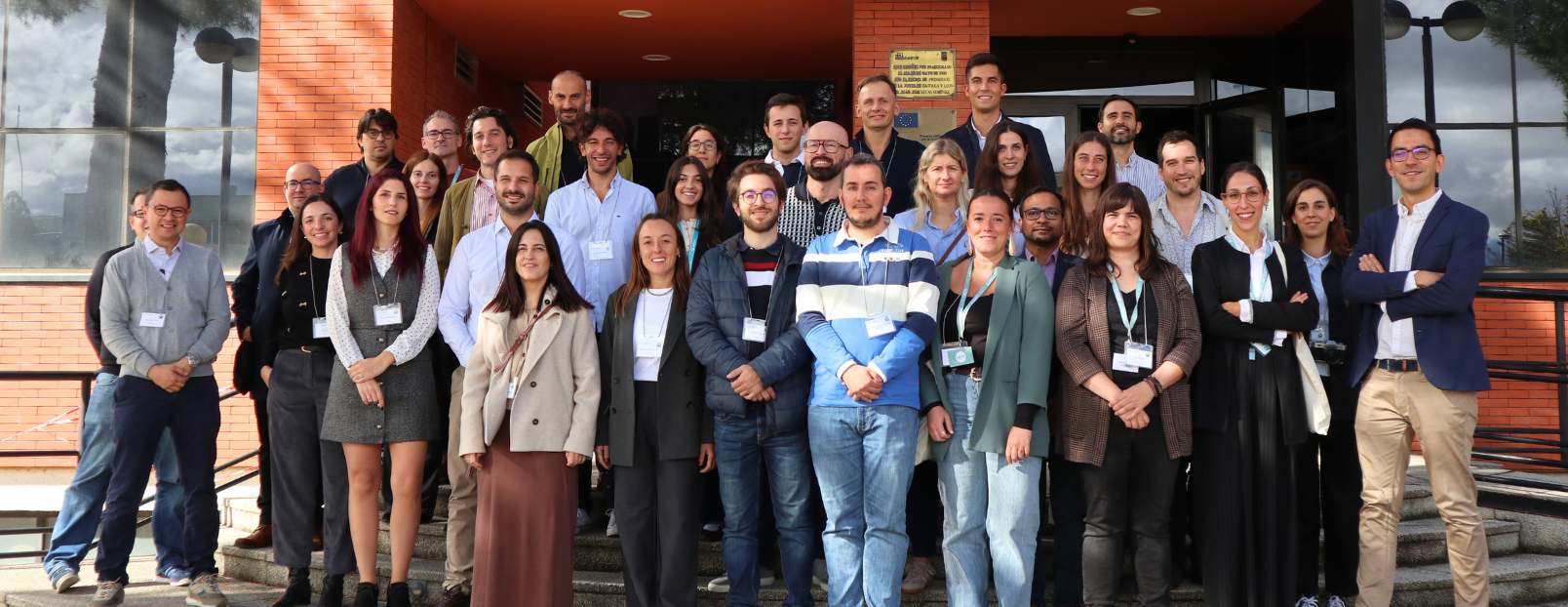
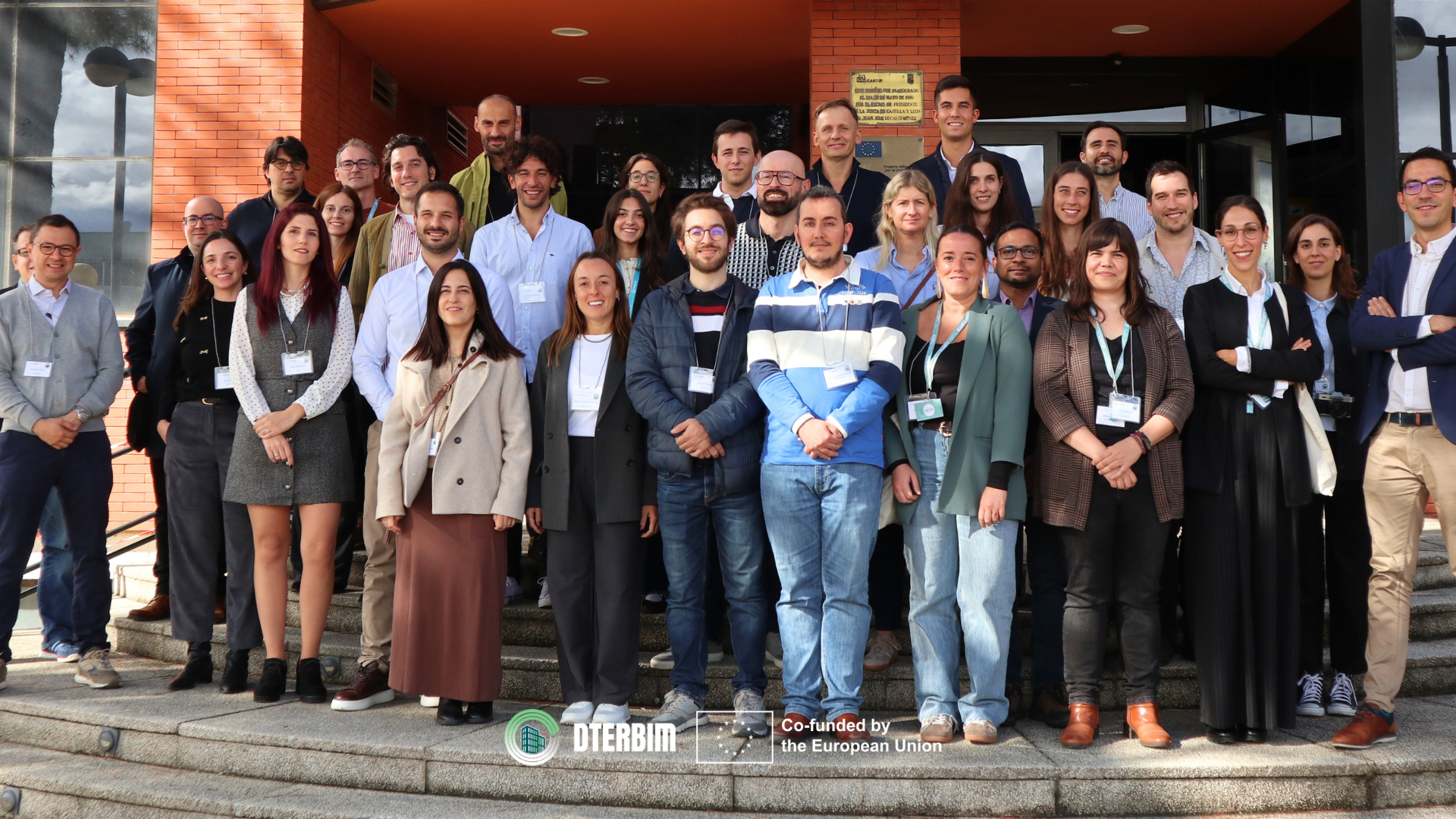
The project officially kicked off on 29-30 October 2025 at the CARTIF Technology Centre in Valladolid, Spain, bringing together 18 partners from eight countries for two days of alignment, planning, and a visit to one of the real-life pilot buildings.
A vision for circular, digital, and sustainable renovation
DTERBIM is developing an innovative, interoperable, and adaptable BIM-based methodology, the DTERBIM process, to make building renovation and management more efficient. By optimising resources such as materials, products, and energy, reducing time and costs, and embedding circularity principles from the outset, the project seeks to transform how buildings are designed, renovated, and managed.
At the centre of this approach is the DTERBIM Toolkit, a suite of user-friendly digital tools, AI-powered services, and Digital Twins, all integrated within an openBIM ecosystem. This ecosystem ensures seamless interaction between tools, robust data exchange, and collaboration across stakeholders, empowering the construction sector to make informed, sustainable decisions throughout the building lifecycle. From design and construction to operation, maintenance, deconstruction, and reuse.
“The DTERBIM project aims to demonstrate how digitalisation can transform the way we design, renovate and manage buildings, integrating circularity for a more efficient and sustainable process. By combining digital technologies such as BIM, Artificial Intelligence, and Digital Twins, it will help improve material traceability and enable more informed decision-making throughout the building lifecycle. Ultimately, DTERBIM aspires to take a decisive step toward a more innovative, circular, and connected Architecture, Engineering, and Construction (AEC) sector,” says Sonia Álvarez Díaz, Project Coordinator, CARTIF.
Five pilot projects across Europe
DTERBIM will validate its methodology through two virtual pilots and three real-life building demonstrations:
- A residential historical building in Valladolid, Spain
- An academic building in Warsaw, Poland
- A kindergarten and elementary school in Athens, Greece
These pilots aim to deliver measurable results, including up to 15% reductions in costs and time, 35% improvements in building performance, and 15% of materials saved for reuse, while engaging over 60 SMEs at local and regional levels.
By aligning with key EU initiatives and incorporating participatory approaches, DTERBIM will define and demonstrate a new paradigm for the European construction and renovation sector.
A multidisciplinary consortium driving innovation
The DTERBIM consortium brings together engineering, architecture, computer science, environmental sciences, social sciences, economics, and policy expertise to ensure a holistic approach to innovation and implementation.
Partners include: CARTIF (project coordinator), Mostostal Warszawa, University College London, ICCS - NTUA (Institute of Communication and Computer Systems of NTUA), CEMOSA, CYPE, Contecht GmbH, Live Information System, Buildings Performance Institute Europe, Acciona Construcción, VEOLIA Servicios LECAM, GEOTER, FASADA, Warsaw University of Technology, Hellenic Passive House Institute, Urban Soul Project, Smartflex, and Australo.
DTERBIM is ready to reshape Europe’s renovation sector with digital, circular, and energy-efficient solutions.
Read the full press release here.
For press and collaboration enquiries, contact: dterbim@australo.org
Stay connected with DTERBIM! Subscribe to our newsletter and follow us on LinkedIn, X, Bluesky, and YouTube for the latest updates, project insights, and stories from our community.