
DTERBIM Newsletter #4: shaping the future of building renovation
In this issue, we invite you to share your views on the future of building renovation through our new survey (by 15 October 2026!), take a close look at how we are collecting data in our Polish pilot, and meet more of the people behind our work in our DTERBIM Voices series.
- Ane Ferreiro, Product Owner and Project Manager at CYPE: "Our goal is to create a robust environment that enables smooth data exchange, reliable model validation, and efficient collaboration throughout the entire building lifecycle."
- Agnieszka Łukaszewska, Head of R&D at FASADA: "DTERBIM has the potential to make advanced digital tools and BIM-based solutions more accessible and practical."
- María Ignacia Culell, Project Manager at AUSTRALO: "I would like to see DTERBIM making its innovations and tools more visible and accessible, helping to connect research, industry, and end users."
- Sonia Álvarez Díaz, Project Coordinator of DTERBIM and researcher at CARTIF Technology Centre: "My focus is on turning the DTERBIM vision into practical digital tools that support better decision-making during the design and construction phases."
We also share our latest activities, including our recent events and insights from across the building and construction sector.
Read the DTERBIM newsletter #4
Subscribe for future updates, visit our website, and follow us on LinkedIn, Bluesky, X, and YouTube.


Have your say: Help shape DTERBIM's digital tools for circular building renovation
At DTERBIM, we are developing digital tools to make building renovation more circular, energy-efficient, and data-driven. But to get there, we need to hear from the people working across the construction sector every day. That is why we have launched a survey on our DTERBIM Toolkit: a short questionnaire to gather insights on current practices, challenges, digital maturity, collaboration, and innovation needs across the building lifecycle.
Whether you work in design, construction, management, policy, research, or finance, your experience matters. The insights we collect will shape the development of our Toolkit, ensuring our solutions reflect real industry needs.
What is the survey about?
The survey covers a range of topics relevant to professionals working across the built environment:
- Current practices and workflows in your area of work
- Key challenges in renovation and construction
- Digital maturity and readiness to adopt tools such as BIM and Digital Twins
- Collaboration across the building lifecycle
- Innovation needs for a more circular and efficient sector
Who should take part?
The survey is open to professionals from a wide range of sectors and roles, including architectural and engineering firms, construction contractors, building owners, facility managers, energy consultants, local authorities, research institutions, IT providers, financial actors, materials suppliers, and more.
It is available in English, Greek, Spanish, and Polish, and takes approximately 15 minutes to complete.
Why it matters
At DTERBIM, we are developing an openBIM-based ecosystem of digital tools to support more circular and energy-efficient renovation across Europe. The survey findings will feed directly into the development of practical tools, interoperable BIM workflows, and policy recommendations.
By taking part, you are not just sharing your experience; you are helping to shape the future of how we renovate buildings.
Deadline: 15 October 2026.
The results of the survey will be consolidated to develop a linear workflow for circular energy renovation. This will be disseminated through a webinar. Please provide your email address in the survey to receive updates on the webinar schedule.
Subscribe to our newsletter for future updates and follow us on LinkedIn, Bluesky, X, and YouTube.


DTERBIM Newsletter #3: DTERBIM Voices, latest updates, and upcoming opportunities
The third edition of the DTERBIM newsletter includes our most recent milestones, partner activities, upcoming events, and selected news from across the digital, circular, and energy-efficient construction sector.
What’s inside this third edition?
This newsletter features the launch of DTERBIM Voices, our new interview series highlighting the people, expertise, and ideas driving our work forward. The first interviews feature Dimitrios Rovas (University College London) and Stathis Stamatopoulos (ICCS/NTUA), who share how their teams are contributing to the development of solutions for smarter building renovation.
It also contains updates from our partners, highlights from our first periodic meeting in Brussels, details of upcoming events, such as the webinar on 9 July, where our coordinator, Sonia Álvarez (CARTIF), will present our work and discuss how Digital Twins and AI can help build more climate-resilient cities, and a curated selection of insightful resources on construction innovation.
Read the DTERBIM newsletter #3
Subscribe for future updates, visit our website, and follow us on LinkedIn, Bluesky, X, and YouTube.
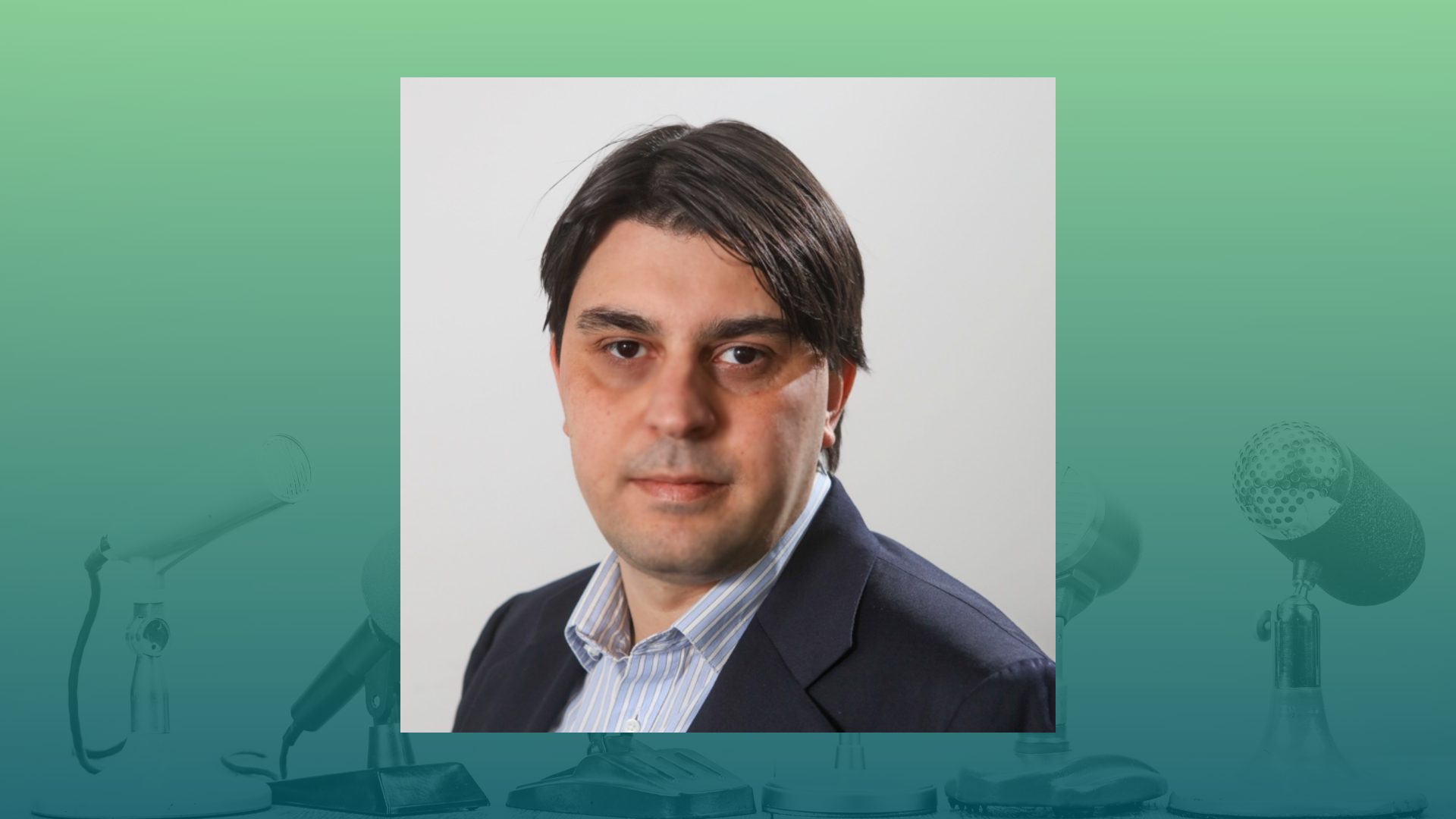
Dimitrios Rovas (UCL): "The wider ambition is a built environment in which good data quality is the foundation for lower-carbon, lower-cost, and more circular renovation"
How can we ensure that digital building models contain the information needed to support better renovation decisions? In this interview, Dimitrios Rovas, Professor of Building Simulation and Optimization at University College London (UCL), explains how his team is helping establish the BIM-based process, data requirements, and quality assurance methods on which DTERBIM relies, and reflects on the challenge of making digital building models more reliable.
Let's start with you. Could you briefly introduce yourself? What is your background, and what work do you focus on currently?
My name is Dimitrios Rovas, and I am a Professor of Building Simulation and Optimization at UCL, within the Bartlett School of Environment, Energy and Resources. My background is in mechanical engineering, but for more than a decade, my work has centred on information management: specifically, how digital building information can be made reliable enough to support decisions across a building’s whole life. This spans BIM-based data modelling, semantic sufficiency, and the enrichment of models to ensure they are fit for simulation and analysis. I have pursued these questions through a series of European projects, including COGITO, BIMERR, BuildON, CBIM, and DigiBUILD.
What do you enjoy most about your work? What keeps you motivated?
What I find most rewarding is working where research meets practice. The questions are genuinely difficult, yet the answers have to survive contact with real buildings and real project teams. I am motivated above all by the gap between what digital models could do and what they currently do; closing it means the information we produce becomes something practitioners can trust and reuse, rather than a model that is built once and then set aside. Watching a method move from a paper to a pilot site, and seeing it hold up there, is the part I enjoy most.
"Watching a method move from a paper to a pilot site, and seeing it hold up there, is the part I enjoy most."
Now let's zoom in on your role within DTERBIM. What is your team responsible for? What challenge are you addressing?
UCL leads Work Package 3, which defines the integrated, BIM-based process on which the rest of DTERBIM is built. In practice, this means we are responsible for establishing how information should flow across a building’s lifecycle, from early design through to eventual deconstruction, and for ensuring that the digital models and tools used along the way share a common, open language.
We coordinate the partners who specify what data each stage requires, who define the openBIM tools and standards that carry it, and who prepare the pilot building models so that they are fit for the analyses the project depends on.
UCL’s own technical contribution lies in two areas in particular:
- assessing whether each pilot model holds enough information for its intended use,
- and developing the methodology for checking, correcting, and enriching those models where it does not.
The challenge is a long-standing one in the sector. Building models are usually produced for a single purpose, such as design or visualisation, and are then reused for tasks they were never prepared for, such as energy simulation, automated compliance checking, or lifecycle and circularity assessment. When information is missing or inconsistent, whether incomplete heating and cooling data, undefined space boundaries, or weak links between static and sensor data, those analyses become unreliable or impossible. Our work establishes how to systematically identify these gaps and close them, so that the pilot models become dependable digital assets for the whole project.
"Building models are usually produced for a single purpose, such as design or visualisation, and are then reused for tasks they were never prepared for."
What has your team achieved so far? And what are your main goals for the next phase of the project?
The work has started strongly, and much of this first year has gone into understanding the problem and beginning to build the foundations on which the rest of the project will stand. This remains very much an ongoing process. We are working with the partners to understand what information and data each stage of a renovation actually requires, and to express those requirements in open, machine-readable standards; in parallel, we have started to examine the existing models for the three pilots in Spain, Poland, and Greece, gradually building a picture of where they are complete and where they fall short.
For the next phase, our priorities are to consolidate the data sufficiency analysis and to develop a practical enrichment methodology; this is a clear set of guidelines that partners can follow to raise the quality of their models, improve geometry and semantic consistency, and add the information needed for reliable energy and circularity analysis. Because these outputs feed into the design, construction, and operation tools developed elsewhere in DTERBIM, establishing the underlying process carefully now matters a great deal for what follows.
In your view, what is the most significant impact DTERBIM could have on the construction sector? What changes would you like to see as a result of your work on the project?
The most significant impact, in my view, would be to make high-quality, information-rich building models the norm rather than the exception. At present, a great deal of effort across the sector is wasted because digital models cannot be trusted to support the analyses we want to run on them; people fall back on manual checks, re-enter data, or forgo the more advanced assessments altogether.
"The most significant impact, in my view, would be to make high-quality, information-rich building models the norm rather than the exception."
If DTERBIM succeeds, I would like to see two changes in particular. First, that checking and enriching a model against clear, shared information requirements becomes a routine, semi-automated step rather than a bespoke struggle each time. Second, that this reliability unlocks better decisions across the building lifecycle: more confident energy renovation, genuine material reuse, and digital twins that practitioners actually depend on. The wider ambition is a built environment in which good data quality is the foundation for lower-carbon, lower-cost, and more circular renovation.
This is the first in a series of interviews with DTERBIM partners, highlighting the people, expertise, and innovations driving the project forward.
Want to meet more of the experts behind DTERBIM? Follow us on LinkedIn, Bluesky, X, and YouTube, and subscribe to our newsletter for future interviews and project updates.
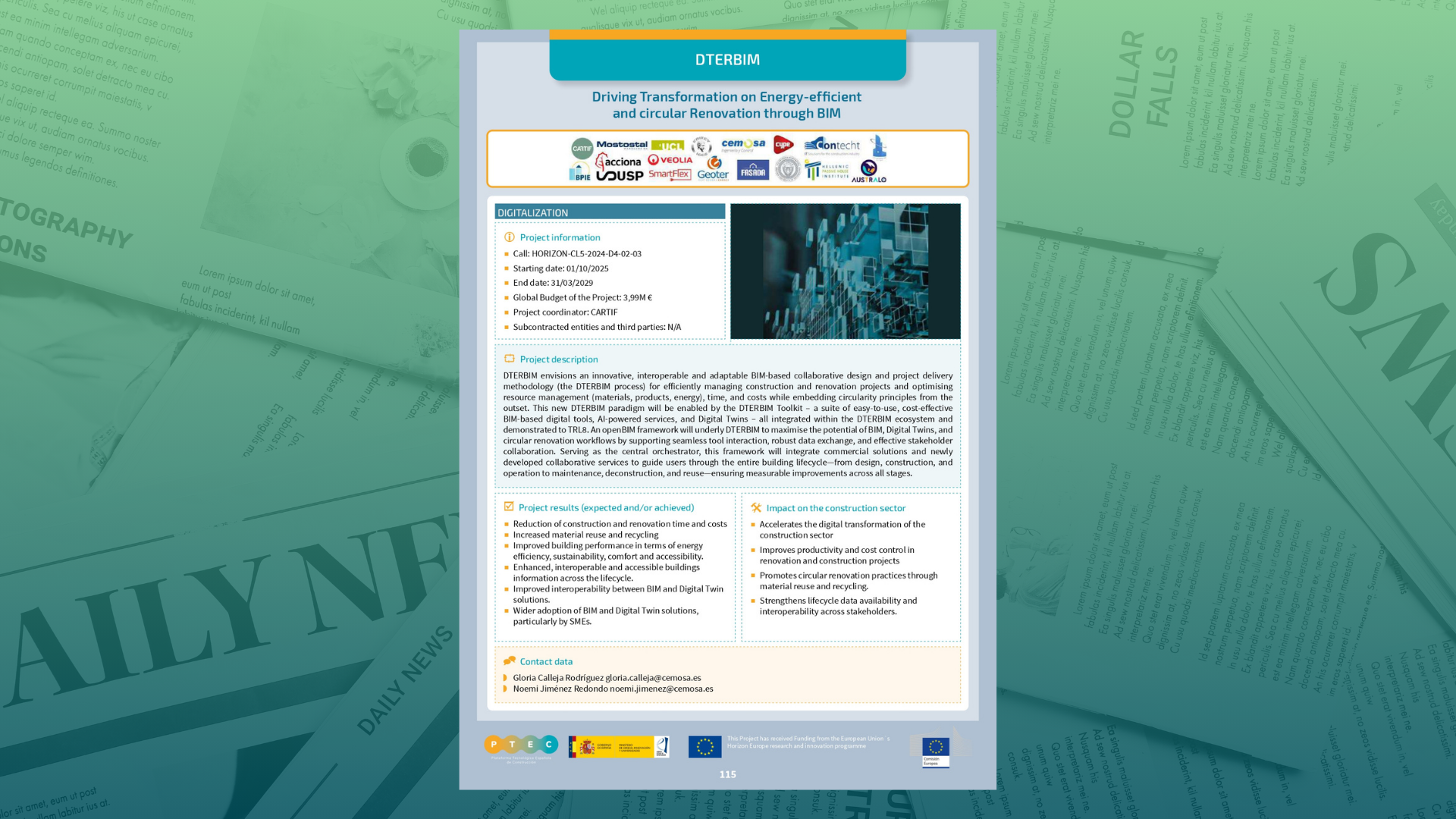
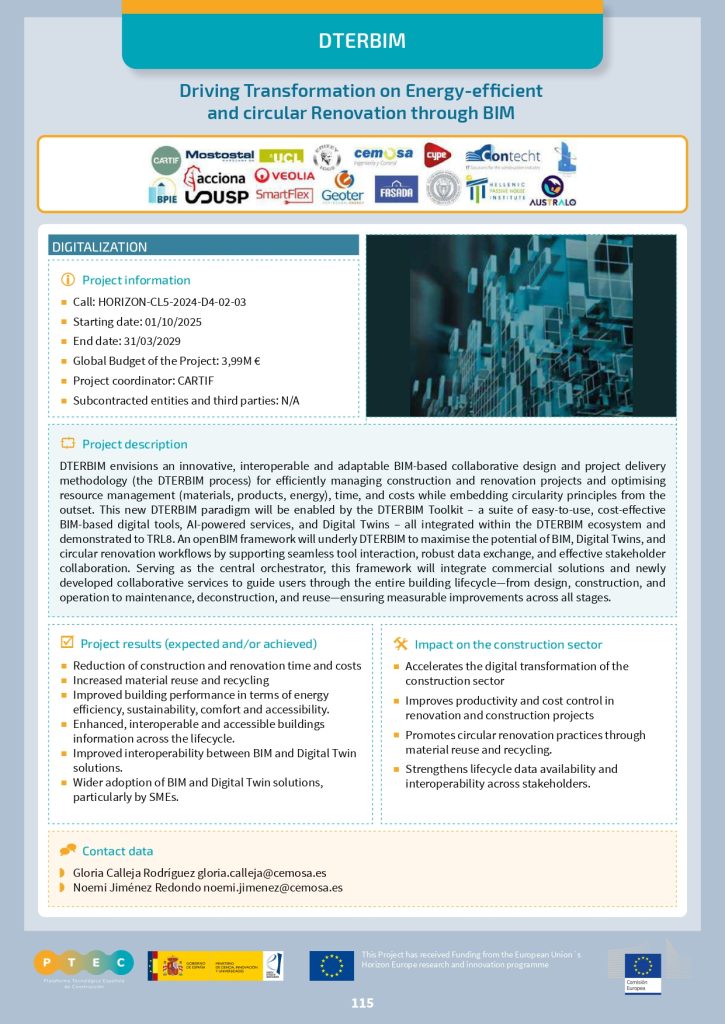
DTERBIM appears in the PTEC 2025 Projects Yearbook through partner CEMOSA
DTERBIM has been featured in the Spanish Construction Technology Platform (PTEC) 2025 Projects Yearbook, a publication that brings together leading national and European initiatives driving innovation in the construction sector.
The publication includes projects organised around key thematic areas shaping the future of construction, including digitalisation, sustainability, circularity, and energy transition. DTERBIM is included among the European projects contributing to a more digital, interoperable, and resource-efficient built environment.
Recognising CEMOSA’s contribution to innovation
This edition features 23 European projects, 11 of which involve our partner CEMOSA, including DTERBIM alongside initiatives such as BEGONIA, OMICRON, SARIL, DeCO2, INHERIT, MOVEO, openDBL, and EBENTO.
CEMOSA is also involved in several national projects focused on strategic areas such as sustainable cities and mobility, digitalisation of river basins, and energy transition.
This recognition reflects CEMOSA’s ongoing commitment to developing innovative solutions that contribute to a more sustainable, digital, and efficient construction sector.
DTERBIM’s vision for digital and circular renovation
As presented in the publication, at DTERBIM we are developing an open, interoperable and adaptable BIM-based collaborative methodology — the DTERBIM process — to improve the management of construction and renovation projects across the entire building lifecycle.
Through our DTERBIM Toolkit, a suite of user-friendly, cost-effective digital tools, AI-powered services, and Digital Twins integrated within an openBIM ecosystem, we aim to support more efficient workflows, stronger stakeholder collaboration, and better management of materials, energy, time, and costs while embedding circularity principles from the beginning.
Explore the PTEC 2025 Projects Yearbook to learn more about the many innovation projects helping shape the future of construction.
Join our community to receive updates, visit our website, and follow us on LinkedIn, Bluesky, X, and YouTube.
DTERBIM holds its first periodic meeting in Brussels
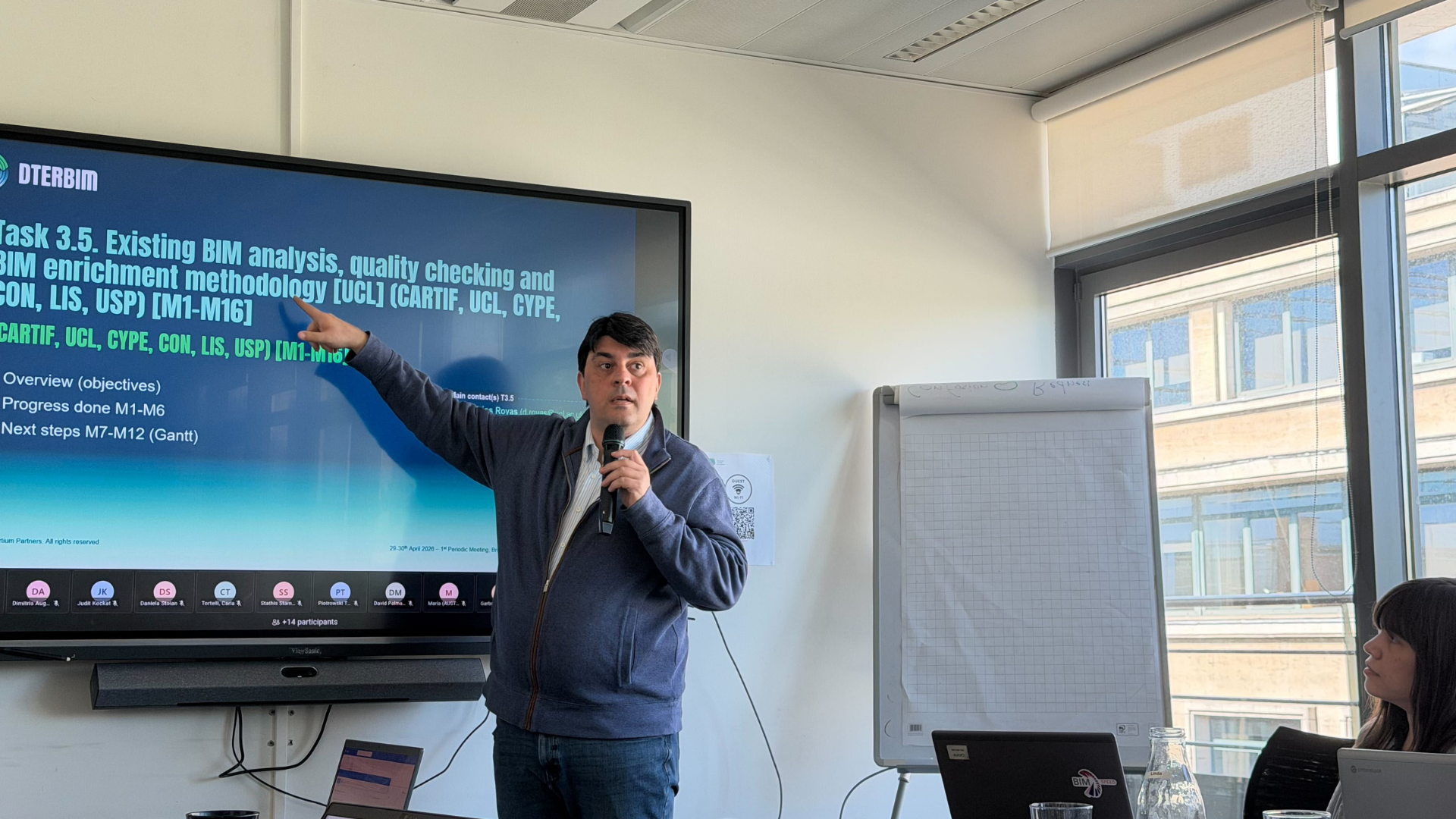
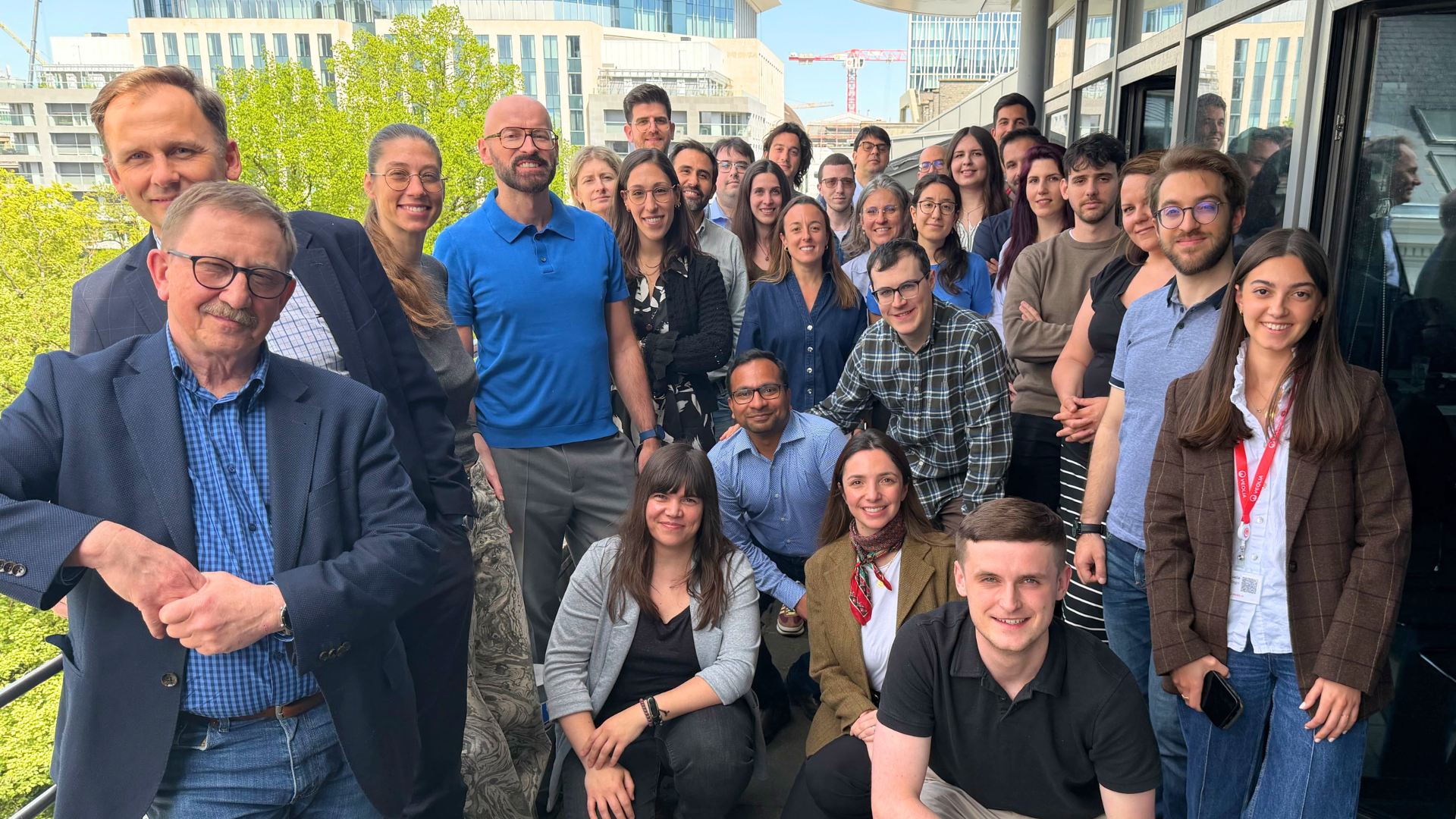
The DTERBIM team came together in Brussels for its first periodic meeting, an important milestone in the project's first phase. Hosted by the Buildings Performance Institute Europe (BPIE) on 28 and 29 April 2026, the two-day meeting brought together representatives from the project's 18 partner organisations to review progress, address challenges, and align on the next steps.
The meeting started with a welcome by BPIE and a project overview from the coordinating partner, CARTIF, followed by a review of progress across project management and coordination.
The session offered a valuable opportunity to reflect on the progress achieved so far and clarify priorities for the months ahead, as well as time to reconnect in person and coordinate across technical and pilot activities.
The discussions also highlighted a shared understanding across the consortium: innovation is not only about developing advanced digital tools, but about making them practical, efficient, and adaptable to the everyday realities of the renovation sector. Keeping solutions simple, useful, and shaped by the people who will use them will be an important focus in the months ahead.
Technical progress across the board
A significant part of the first day was dedicated to updates from the project's core technical areas. Partners presented progress on the integrated BIM-based process definition, covering topics such as the development of circular energy renovation workflows, data needs and collection methodology based on openBIM standards, and approaches to BIM quality checking and enrichment.
Teams working on digital tools for efficient, circular and sustainable design and construction shared advances in several areas, including an SRI-aligned catalogue of energy conservation measures, early design tools integrating circularity and inclusiveness, semi-automatic upgrade of BIM models based on the DTERBIM catalogue, and a Building Material Passport for tracking construction products across their lifecycle. Updates on digital tools for operation, maintenance, and deconstruction (reuse and recycling) concluded the first day’s technical sessions.
Partners then presented progress on the DTERBIM interoperable openBIM framework, a key aspect of our mission to create a connected, standards-aligned digital ecosystem for the built environment.
The communications and dissemination team also reported on activities from the first phase, covering outreach, communication channels development, and early exploitation and innovation management planning.
Workshops: getting into detail
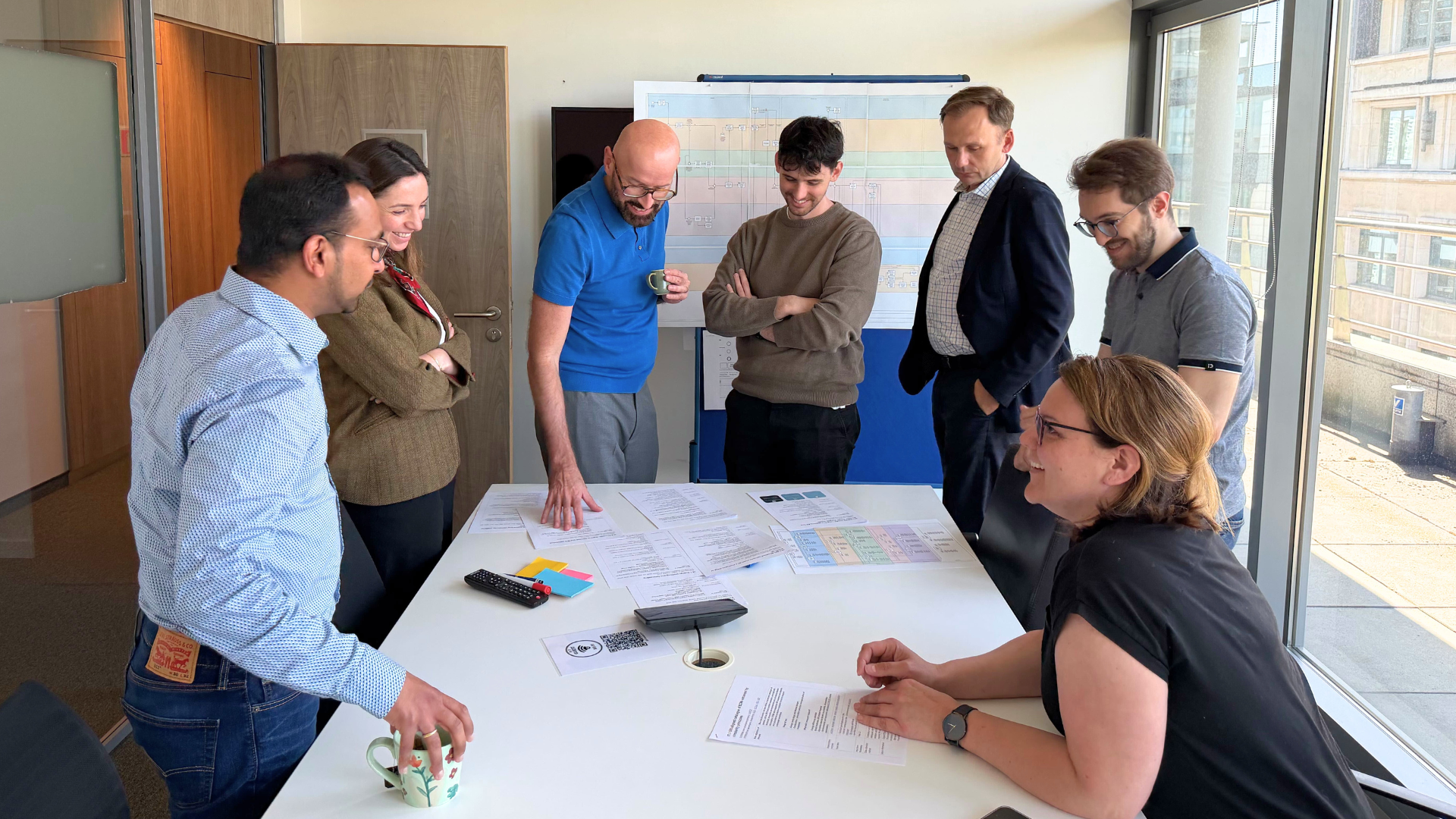
Two dedicated workshops gave partners the space to work collaboratively on some of the meeting's most substantive topics. The first focused on the workflow for circular energy renovation supported by participatory approaches, a thread that connects technical development with real-world stakeholder engagement. The second centred on defining use cases for scenario-based process validation, a critical step towards ensuring that DTERBIM's tools and methodologies hold up under real conditions.
Pilots take centre stage
Day two opened the floor to the project's real-life and virtual pilot teams. Representatives from the Spanish, Greek, and Polish pilot sites, covering buildings in Valladolid, Athens, and Warsaw, respectively, presented their progress on data collection and preparation, a reminder that all the technical work ultimately lands in real buildings, with real obstacles and opportunities.
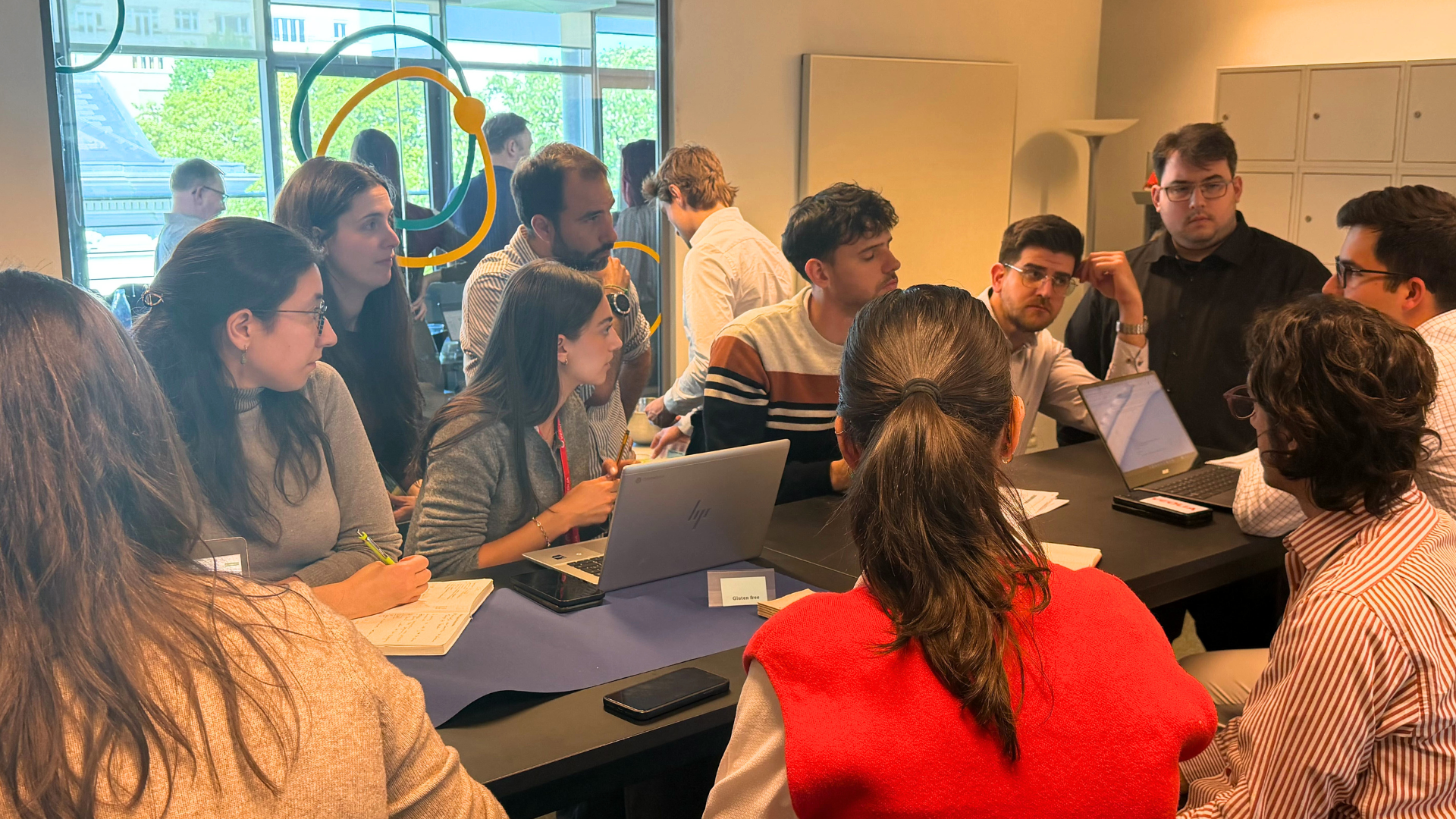
The meeting closed with a session on conclusions and open questions, giving the DTERBIM team an overview of key next steps. With pilots progressing, tools taking shape, and the openBIM framework advancing, DTERBIM is entering an exciting new phase.
Over the coming months, the consortium will focus on deepening the technical work, advancing pilot validation, and continuing to engage the wider sector, while demonstrating how digital tools can accelerate circular and energy-efficient renovation across Europe.
Subscribe for future updates, visit our website, and follow us on LinkedIn, Bluesky, X, and YouTube.